WordPress runs over 40% of every website on the internet, which means a lot of business owners are responsible for one. Most of the trouble that comes up on WordPress sites traces back to the same handful of mistakes.
The good news is that they can be fixed. Here they are.
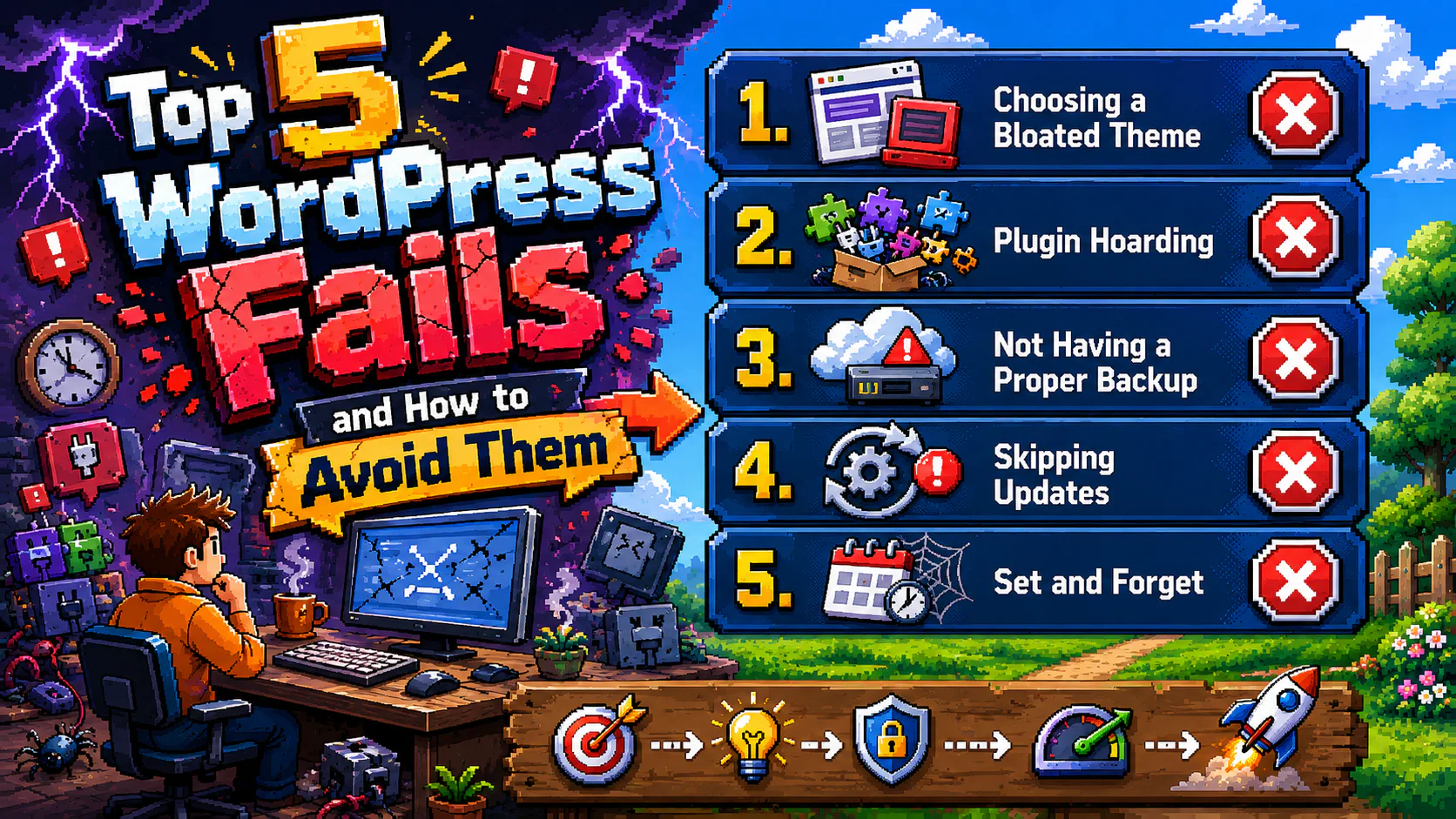
1. Choosing a Bloated Theme
A bloated theme is one that ships with hundreds of features you’ll never use, usually packaged with a heavy page builder. It loads slowly, fights with plugins, and makes your site harder to maintain.
You’ll know one when you see it. The demo has fifty homepage layouts, twenty header styles and a slider with seven animation modes. It looks like a lot of value for your money. It isn’t.
Every feature you don’t use is still code your site has to load. Google measures how fast your pages render and respond, and slow sites rank lower in search results. Patchstack discovered more high-severity vulnerabilities in WordPress in 2025 than in the previous two years combined, and themes accounted for 9% of them. A lean theme has less surface area for problems.
The fix: Choose a lightweight, well-maintained theme with a clear development history. If you need a custom design, get one built rather than buying a template and fighting with it for years.
2. Plugin Hoarding
The average WordPress site runs between 20 and 30 plugins. That’s not because every site needs 30 plugins. It’s because plugins are easy to install and almost no one uninstalls them.
Why Does Reducing Plugins Make Sites More Secure?
Every plugin you install is a piece of code written by someone outside the WordPress core team. According to Patchstack (2026), 91% of WordPress vulnerabilities in 2025 came from plugins, and 43% of those could be exploited without any login credentials. The fewer plugins you run, the smaller your attack surface.
It’s not just security. Fewer plugins means fewer conflicts when WordPress updates, fewer slow-loading scripts, and fewer paid licences to renew. The leanest WordPress sites are usually the easiest ones to manage.
The maths is straightforward. More plugins, more risk.
How to audit your plugins:
This doesn’t mean plugins are bad. It means each one needs to earn its place. A contact form plugin you use every day is worth its weight. A “related posts” plugin you installed in 2022 and forgot about is a liability.
- List every active plugin on your site
- For each one, ask when you last actually used it
- Check when it was last updated by the developer
- Remove anything you don’t need, or that hasn’t been updated in over a year
If you’re not sure what a plugin does or why it’s there, that’s a problem worth fixing.
3. Not Having a Proper Backup
If your site went down right now, how would you get it back?
A lot of business owners assume their hosting company handles this. Some do, some don’t, and the ones that do often keep backups for a few days at most. That’s fine if you notice a problem within 24 hours. It’s not fine if a plugin update breaks something subtle and you don’t catch it for a week.
A proper backup means three things. It runs automatically, it stores copies off-site (not on the same server as your website), and you’ve actually tried restoring from one.
That last bit matters. A backup you’ve never tested is not a backup. It’s a hope.
Tools like UpdraftPlus, BackupBuddy and BlogVault all handle automated off-site backups. Most managed WordPress hosts (WP Engine, Kinsta, SiteGround) include daily backups as part of the plan. Either path works. What doesn’t work is assuming someone else has it covered without checking.
The fix: Confirm where your backups go, how often they run, how long they’re kept, and how to restore from one. If you can’t answer all four, you don’t have a backup strategy.
4. Skipping Updates
WordPress, your theme and your plugins all get updates regularly. Some are new features. Many are security patches.
Patchstack’s 2026 report has a number that should change how you think about this. The median time between a vulnerability being publicly disclosed and it being mass-exploited is five hours. Automated bots scan for known vulnerabilities and attack within hours of a fix being published.
When you delay an update by a week because the timing isn’t convenient, you’re leaving your site exposed for that week.
But here’s the catch. Updates can also break things. A plugin update can clash with your theme. A WordPress core update can affect a custom integration. This is why most businesses end up doing one of two things. Either updating in a panic when something breaks, or never updating at all because they’re scared something will break.
Neither works.
A sensible update routine:
- Test updates on a staging site before pushing them live (any decent host provides this)
- Run updates on a regular schedule, not when you remember
- Keep a record of what was updated and when
- Have someone who can roll back quickly if an update causes problems
If your team can’t do this, an agency or managed host should be doing it for you. It’s not optional.
5. Set and Forget
The biggest WordPress fail isn’t technical. It’s treating your website like a piece of furniture.
You wouldn’t ignore a $50,000 vehicle for three years and expect it to still drive well. Your website is the same. It needs ongoing attention, even when nothing is obviously wrong.
Set-and-forget WordPress sites slowly degrade in the background. Plugins go out of date. Performance drifts. Forms quietly stop sending. Analytics tracking breaks during a theme change, and no one notices for six months. Then, usually, something visible goes wrong, and the owner discovers the underlying neglect all at once.
The healthy approach is much smaller. A monthly check-in where someone looks at the site is enough for most businesses. What’s loading slowly? What plugins need attention? Are forms still working? Is Google Analytics still tracking? Did anything change in the last 30 days that we didn’t expect?
This is what good website management actually looks like. Not a major overhaul. Regular, small attention.
Comparing the Fixes
Some of these fails are quick to address. Others take real planning. Here’s how they sort.
| Fail | Time to fix | Cost | Risk if ignored |
|---|---|---|---|
| Bloated theme | High (often needs rebuild) | Medium-high | Slow site, poor SEO |
| Plugin hoarding | Low-medium | Free to low | Security and performance |
| No backup | Low | Free to low | Total site loss |
| Skipping updates | Ongoing | Time or service fee | High security risk |
| Set and forget | Ongoing | Monthly service fee | Slow decline, then crisis |
Where to Next
If any of these five sound familiar, the next step is a proper look at your site. Not a “let’s rebuild it” conversation, just a real assessment of what’s working, what’s at risk and what needs attention.
A website audit is a sensible starting point. It catches the things that aren’t obvious from the front end. Slow plugins, security gaps, missed updates, and performance drift. All before they become a problem, you have to deal with them under pressure.
For more on staying ahead of WordPress security specifically, see our guide on How to Secure Your WordPress Website.
Talk to us about your website.