WooCommerce for WordPress is a free, open-source plugin that turns a WordPress site into a fully functional online store. It adds product management, payments, shipping, and a storefront on top of WordPress. No monthly platform fee. No locked-in checkout. Just a plugin you install on a WordPress site you already own.
That approach has made it the most used ecommerce platform in the world. More than 4.4 million live stores run on WooCommerce, according to StoreLeads (May 2026).
If you’re choosing an ecommerce platform in 2026, the question isn’t whether WooCommerce works. It does. The question is whether it’s the right fit for the kind of store you want to run.
What Is WooCommerce, and How Does It Actually Work?
WooCommerce is a WordPress plugin that adds full ecommerce functionality to a WordPress website. It works by adding product types, a shopping cart, a checkout flow, payment integrations, shipping options, and an order management dashboard to your existing site.
Unlike Shopify or BigCommerce, WooCommerce is not a standalone platform. You need a WordPress website running first. Once that’s in place, installing WooCommerce takes a few minutes from the WordPress admin.
The core plugin is enough to run a real store. You can sell physical products, digital downloads, services, bookings or subscriptions. You can accept card payments, manage inventory, run discounts, ship orders and pull reports on what’s selling.
Because it’s open source, the code is yours to inspect, modify and extend. That’s a meaningful difference from hosted platforms, where the code stays on someone else’s servers, and your customisation options are whatever they decide to expose.
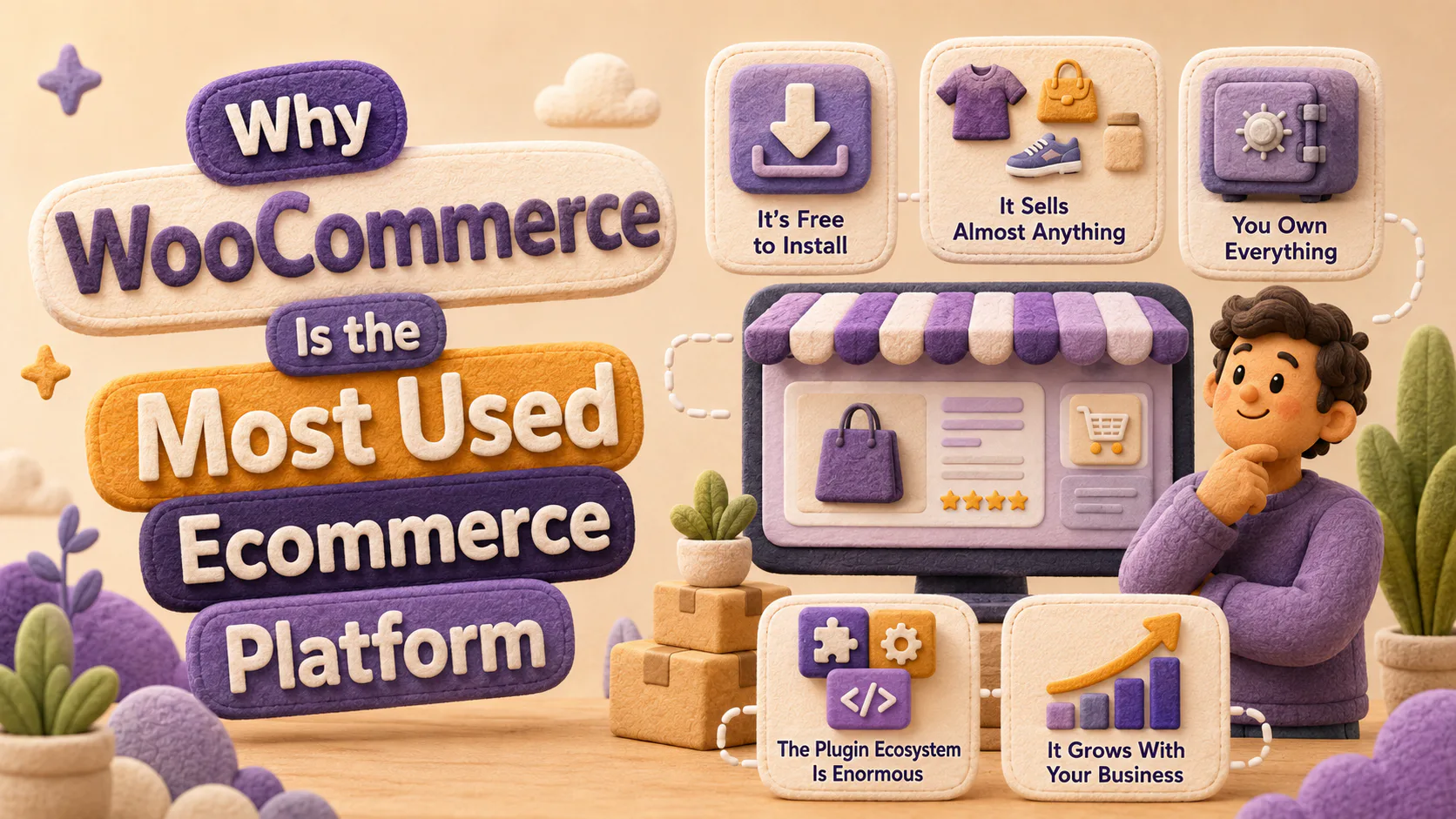
Why WooCommerce Is the Most Used Ecommerce Platform
WooCommerce holds around a third of the global ecommerce market by store count, ahead of every other platform. There are good reasons for that.
It’s Free to Install
The plugin costs nothing. WordPress costs nothing. You will pay for hosting, a domain, and likely some premium extensions over time, but there is no monthly platform fee taking a slice of your business.
Compare that to Shopify, where pricing in Australia starts at AU$56 per month for the Basic plan and climbs to AU$575 for Advanced, with an additional transaction fee of up to 2% if you don’t use Shopify Payments. WooCommerce charges none of that.
The catch is that “free to install” is not the same as “free to run.” Colorlib estimates the total cost of ownership for a serious WooCommerce store at $2,000 to $10,000 per year, covering hosting, premium extensions, and ongoing maintenance (2026). That’s still often less than a comparable Shopify setup once apps and transaction fees are added, but the savings aren’t automatic.
It Sells Almost Anything
The core plugin handles physical and digital products out of the box. Add an extension, and you can sell:
- Services with booking calendars
- Memberships with gated content
- Subscriptions with recurring billing
- Online courses
- Event tickets
- B2B catalogues with tiered pricing
Few platforms cover this range without locking parts of it behind enterprise tiers.
You Own Everything
When you build on WooCommerce, the site, the data, the customer list and the code all sit on infrastructure you control. It won’t suddenly change its pricing model, deprecate a feature you depend on or restrict what you sell. Also, for businesses subject to GDPR or strict data residency rules, that ownership matters.
The Plugin Ecosystem Is Enormous
The official WooCommerce Marketplace lists more than 1,300 free and premium extensions. Beyond that, the wider WordPress ecosystem has more than 55,000 plugins compatible with WooCommerce (Marketing LTB, 2026). No other ecommerce platform comes close to that breadth.
Whatever feature you need, someone has probably built it. Payment gateways for every region. Shipping integrations with every major carrier. Marketing tools, accounting tools, tax calculators, CRM connectors, you name it.
It Grows With Your Business
You can launch on a basic shared host with three products and scale to a six-figure store without changing platforms. The same WordPress site that handled your first sale will handle your ten-thousandth, provided you upgrade hosting and infrastructure as you grow.
What WooCommerce Will Actually Cost You
While WooCommerce itself is free, the real cost of running a store depends on what you build.
Hosting
Your store needs WordPress hosting that can handle ecommerce traffic. Cheap shared hosting will fall over the first time you run a campaign. Plan to spend somewhere between $30 and $200 AUD per month for hosting that won’t embarrass you, depending on traffic and how many products you stock.
Premium Extensions
The free core covers the basics. Most stores end up paying for at least a few premium extensions for things like advanced shipping rules, subscription billing, or specific payment gateways. Pricing varies widely. Some are one-off, some are annual.
Theme
A free theme is fine to start with. Most growing stores eventually invest in a premium theme or, more sensibly, a custom-designed one that reflects the brand and the way customers actually shop.
Development
If you want anything beyond what extensions provide off the shelf, you’ll need a developer. That’s true of any platform, but with WooCommerce, you’re not constrained by what the platform allows. You’re constrained by your budget.
For a fuller breakdown of what goes into an ecommerce build, see our website design and development service page.
Where WooCommerce Isn’t the Right Fit
WooCommerce works best for businesses willing to own the technical side. If that’s not you, the same things that make it powerful make it the wrong choice.
If you don’t want to think about hosting, it is not for you. A badly configured server will make your store slow, and slow stores convert poorly. Sites loading in under two seconds convert roughly twice as well as slow ones (Marketing LTB, 2026). A hosted platform like Shopify takes that decision off your hands.
Is someone going to maintain it? If not, you might want to look for a hosted option. WordPress updates, plugin updates, security patches and backups are your responsibility, or your agency’s. Neglected, the site gets vulnerable. We’ve written before about what happens if your website gets hacked and what it takes to secure a WordPress website.
Can you get it built properly? There’s a learning curve to WooCommerce, especially if you’re not familiar with WordPress. It can get complicated depending on the features you want. A poorly built WooCommerce store can become a tangle of conflicting plugins. If you’re not skilled enough, you can either hire someone else or opt for a hosted option.
When WooCommerce Is the Right Call
WooCommerce makes sense when:
- You already run a WordPress site and want ecommerce on top
- Content marketing is central to how you sell (WordPress and SEO go together naturally)
- You want full control of your data and code
- Custom functionality is likely to be on the cards eventually
- You want to avoid paying monthly platform fees and percentage cuts
It’s less ideal when you want zero maintenance, are happy paying for that convenience, and don’t need much customisation. In those cases, a hosted platform is usually the simpler answer.
For a direct comparison of the two most common options, see WooCommerce vs Shopify.
Why Does WooCommerce Need WordPress?
WooCommerce is a plugin, not a standalone platform. WordPress provides the content management system, the user system, the theme framework, and the underlying site structure. WooCommerce extends that with ecommerce functionality.
For most businesses, the standard WordPress and WooCommerce combination is the right choice. It’s well documented, well supported and the easiest path to a working store.
How to Get Started With WooCommerce for WordPress
If you already have a WordPress site, you’re most of the way there. If you don’t, the steps are:
- Choose a hosting provider that supports WordPress well and has experience with ecommerce traffic
- Register a domain and point it to your hosting
- Install WordPress (most hosts offer one-click installs)
- Install the WooCommerce plugin from the WordPress admin
- Run the setup wizard to configure your store, products, payments, shipping and tax
- Choose a theme that suits your brand and customers
- Add your products
- Test the checkout end-to-end before you launch
For most businesses, steps one through eight are where things go wrong, not where they should be doing the work themselves. A capable agency will set this up properly the first time and save you the cost of rebuilding it later.
If you want to think through what should be in a brief before you start, our guide on how to create a website brief is a sensible starting point.
Next Steps
WooCommerce is the right answer for most businesses that want a real ecommerce site with room to grow. It’s not for businesses that want a managed platform and don’t mind paying for that convenience. If you’re not sure which side of that line you’re on, that’s worth a conversation before you commit to a build.
Talk to us about your ecommerce site.