Your website should be doing more than telling people you exist. It should be running parts of the business, generating revenue, capturing leads, supporting customers, and feeding you the data you need to make the next decision. If your site is still functioning as an online brochure, it’s costing you more than you think.
A business website is the operational centre of how your company sells, serves and grows online. It does work. It is not a digital pamphlet.
This shift matters because the cost of a passive website has gone up. Buyers research independently before they ever speak to you. Search engines and AI answer engines pull directly from your site. Customers expect to self-serve. A site that just sits there is, quietly, sending business somewhere else.
Why Does a Brochure Site Cost You Money?
A brochure site costs you money because it forces every interaction into a slower, more expensive channel. A visitor wants pricing, but they have to pick up the phone. A potential customer wants to compare options, and instead they leave to check a competitor. Someone’s ready to buy at 11pm, yet your site won’t let them. Each of these moments is a lost opportunity.
A passive site also leaks in three less obvious ways. Staff time goes to questions that the site should be answering. Marketing spend pushes traffic to pages that don’t convert. And data that should be telling you what customers want is either not collected or not looked at.
According to 6sense’s 2024 Buyer Experience Report, B2B buyers complete around 70% of their decision-making before they ever contact a sales team. If your website isn’t doing the heavy lifting during that 70%, the buyer is forming opinions about you using your competitor’s content.
The fix isn’t more pages. The fix is rethinking what the site is for.
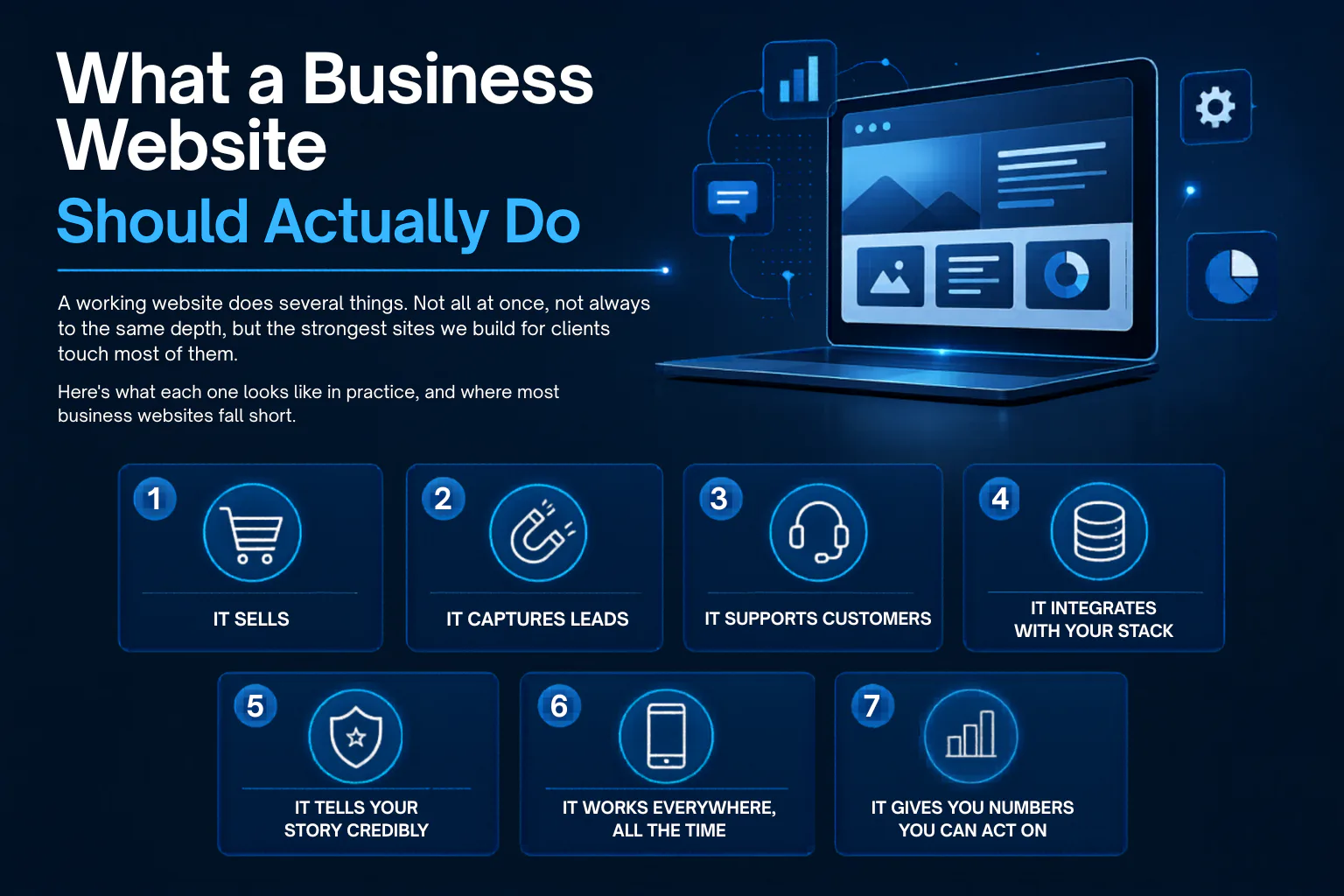
What a Business Website Should Actually Do
A working website does several things. Not all at once, not always to the same depth, but the strongest sites we build for clients touch most of them. Here’s what each one looks like in practice, and where most business websites fall short.
1. It Sells
A business website sells by handling transactions directly. For product businesses, that means ecommerce. For service businesses, that means qualifying leads, booking consultations, taking deposits, or selling productised offers.
The trap is thinking “we don’t sell online” means “we don’t need to sell on the site.” Every business sells on its site. The question is whether the site closes, qualifies, or just hands over a phone number.
2. It Captures Leads
A business website captures leads before interest cools off. That means the right form in the right place, gated content when there’s a real reason to gate it, and clear next steps on every page that matters. Not pop-ups everywhere. Specific, contextual asks that match where someone is in their decision.
A lead form that takes three minutes to fill out converts worse than one that takes thirty seconds. Cut everything you don’t need at first contact.
3. It Supports Customers
The cheapest customer support is the support you don’t have to give. A working site answers the questions customers ask before they ask them. Account access, order tracking, FAQs that are actually useful, knowledge base articles, live chat for the genuinely complex stuff.
This isn’t just cost-cutting. Customers who can self-serve are more satisfied than customers who had to wait on hold to get the same answer.
4. It Integrates With Your Stack
This is where a lot of websites fail quietly. The site collects a lead, then someone copies it into a CRM. An order comes in, then someone keys it into accounting. A booking is made, then someone updates a spreadsheet.
Every manual handoff is a place where errors happen, and momentum dies. The integrations a modern site needs depend on the business, but the principle is the same. Connect the site to the systems that run the work, so data moves on its own.
5. It Tells Your Story Credibly
Brand still matters. But credibility online isn’t built with adjectives. It’s built with proof. Case studies, named clients, testimonials that say something specific, awards, third-party reviews, real photography, real people on the team page.
If a visitor can’t tell from your site that you’ve done this before, they’ll assume you haven’t.
6. It Works Everywhere, All the Time
More than half of web traffic is mobile. A site that works “well enough” on a phone is a site losing half its visitors. The same applies to load times, browser quirks, and accessibility. None of these is optional any more. This is the floor, not the ceiling. A site that fails here doesn’t get to compete on anything else.
7. It Gives You Numbers You Can Act On
With the right analytics tools in place, your website can show you where traffic comes from, how visitors interact once they arrive, which pages generate leads, and much more. If you’re not tapping into these capabilities, you’re leaving valuable insights and potential growth on the table.
What Changes When You Treat Your Site as a Hub
A few things start happening when a business website actually does its job.
Sales conversations get shorter because prospects arrive better informed. Support costs flatten or drop, because customers self-serve the routine stuff. Marketing gets more efficient because you can see which campaigns drive revenue rather than just traffic. And operations get easier, because the systems are talking to each other.
This isn’t a transformation story. It’s a compounding one. Each improvement makes the next improvement cheaper. Six months in, the business runs differently.
How to Tell If Your Site Is Already a Hub
A quick test. Pick a recent week and ask:
How many qualified leads came through the site without anyone manually following up first? What share of customer questions did the site answer before anyone had to step in? Did any orders, bookings or applications move through automatically? What did your analytics tell you to do differently this week?
If most of those answers are zero or “I don’t know,” the site is still a brochure. The good news is that brochure sites can be rebuilt into hubs. The order in which you do it matters more than how much you spend.
If This Sounds Like Your Site
If you read this and recognised your site, the next move isn’t a redesign brief. It’s working out which two or three functions would change the business most if they worked properly. Start there. Build out from a working hub, rather than trying to perfect everything at once.
We’ve helped businesses make this shift across website development, digital strategy and the integration work that ties it all together. The pattern is consistent. The companies that treat their site as operational infrastructure pull ahead of the ones still treating it as marketing collateral.
Talk to us about your website.