Pay-per-click advertising puts your business in front of people at the exact moment they’re searching for what you offer. Unlike organic search, which takes months to build, PPC can drive qualified traffic to your website within hours of launching a campaign.
But here’s the thing most guides won’t tell you upfront: PPC is simple to start and surprisingly easy to waste money on. The difference between a campaign that generates leads at a sustainable cost and one that burns through budget with nothing to show for it comes down to how well you plan, build and manage it.
This guide is practical, not theoretical. If you’re running a business, wearing multiple hats, and trying to figure out whether paid search is worth your time and money, this is for you.

What PPC Actually Is (and Isn’t)
PPC stands for pay-per-click. It’s an advertising model where you only pay when someone clicks your ad. No click, no charge. That’s the appeal, and it’s a genuine advantage over traditional advertising where you pay for exposure regardless of whether anyone acts on it.
When most people say “PPC,” they mean paid search ads, the text-based results that appear at the top of Google or Bing when someone searches for something. These ads are triggered by keywords you choose, and they’re designed to match what the searcher is looking for.
But PPC as a model extends beyond search. You’ll find pay-per-click pricing on social media platforms like Meta and LinkedIn, on display networks that show banner ads across websites, and on video platforms like YouTube. Each of these serves a different purpose and reaches people at different stages of their buying journey.
This guide focuses on paid search PPC, specifically Google Ads, because it’s the most accessible and measurable starting point for most businesses. When someone types “plumber near me” or “accounting software for small business” into Google, they’re telling you exactly what they need. Paid search lets you show up right there, right then.
Why Paid Search Works
There’s a reason paid search has been the backbone of digital advertising for over two decades. It works because it targets intent. The people seeing your ad aren’t passively scrolling a feed or glancing at a billboard. They’re actively looking for a solution, and they’ve told Google exactly what that solution is. That’s why search ads consistently convert at higher rates than display or social advertising. Someone who types “commercial cleaner Brisbane” into Google is much closer to hiring than someone who sees a cleaning ad while scrolling Instagram.
Paid search has a few specific advantages worth understanding.
You control the budget completely. There’s no minimum spend. You can start with $20 a day, see what happens, and scale up once you know what’s working. You can pause campaigns instantly if cash flow tightens or if you’re at capacity. That flexibility matters when every dollar counts.
You get data fast. SEO is a long game, and content marketing builds slowly. PPC gives you real performance data within days. You’ll know which keywords people are clicking, what they do on your website after they arrive, and how much each lead or sale is costing you. That information is valuable even beyond PPC, because it tells you what language your customers use and what they care about.
You can compete with bigger players. In organic search, large companies with established websites and years of content often dominate the first page. Paid search levels the playing field. A well-targeted ad from a local business can appear above a national brand if the ad is more relevant to what the searcher needs.
The catch is that PPC only works this well when it’s set up properly. A poorly structured campaign with broad keywords and a generic landing page will cost you money and deliver very little. The rest of this guide covers how to avoid that.
What It Actually Costs
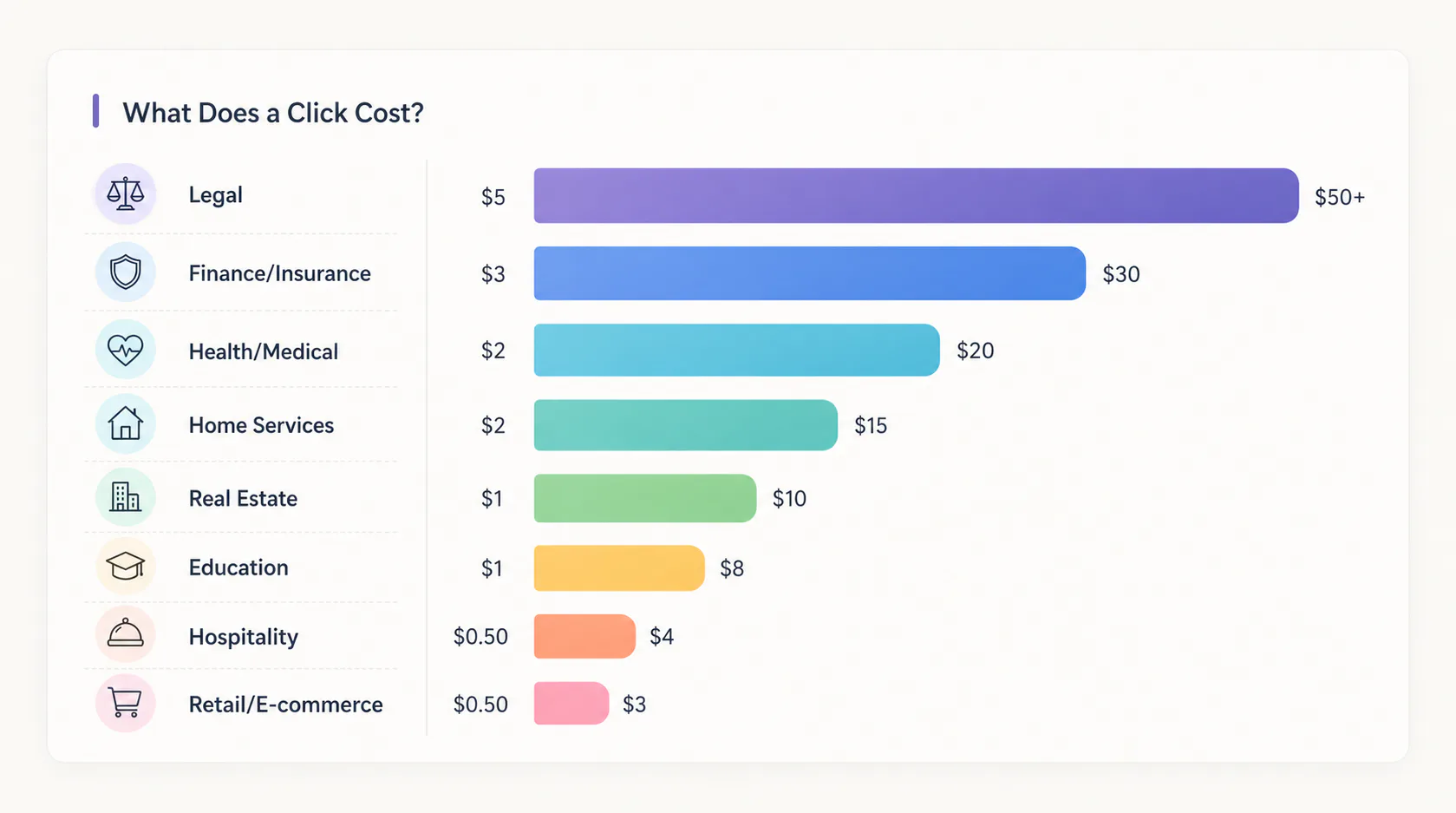
One of the first questions every business owner asks is “how much does PPC cost?” The honest answer is that it depends entirely on your industry, your location, and what you’re competing for.
Some clicks cost less than a dollar. A local dog groomer targeting “dog grooming Brisbane” might pay $2 to $4 per click. A personal injury lawyer targeting “car accident lawyer Sydney,” on the other hand, could be paying $30 to $60 per click, because the value of a single client in that industry is enormous.
The cost-per-click (CPC) is determined by an auction. Every time someone searches, Google runs a real-time auction among all the advertisers targeting that keyword. Your ad’s position depends on two things: how much you’re willing to bid, and your Quality Score, which is Google’s assessment of how relevant and useful your ad and landing page are to the searcher.
This is where smaller businesses actually have an edge. Google rewards relevance. A local electrician with a tightly focused ad and a well-built landing page can outrank a national franchise bidding more money but running generic ads. Quality Score is the great equaliser, and it’s something you can directly influence.
For budgeting purposes, most businesses we work with start somewhere between $1,000 and $5,000 per month on ad spend, plus management costs if they’re working with an agency. The key metric isn’t how much you spend. It’s your cost per acquisition: how much it costs you to get a paying customer. If you’re spending $2,000 a month and generating $10,000 in revenue from those leads, the spend is justified. If you’re spending $2,000 and getting nothing measurable back, something needs to change.
Building a Campaign That Actually Works
Setting up a Google Ads campaign isn’t complicated. Setting one up well takes more thought. Before you touch the platform, you need three things clear in your head: what you’re trying to achieve, who you’re trying to reach, and where you’re sending them once they click.
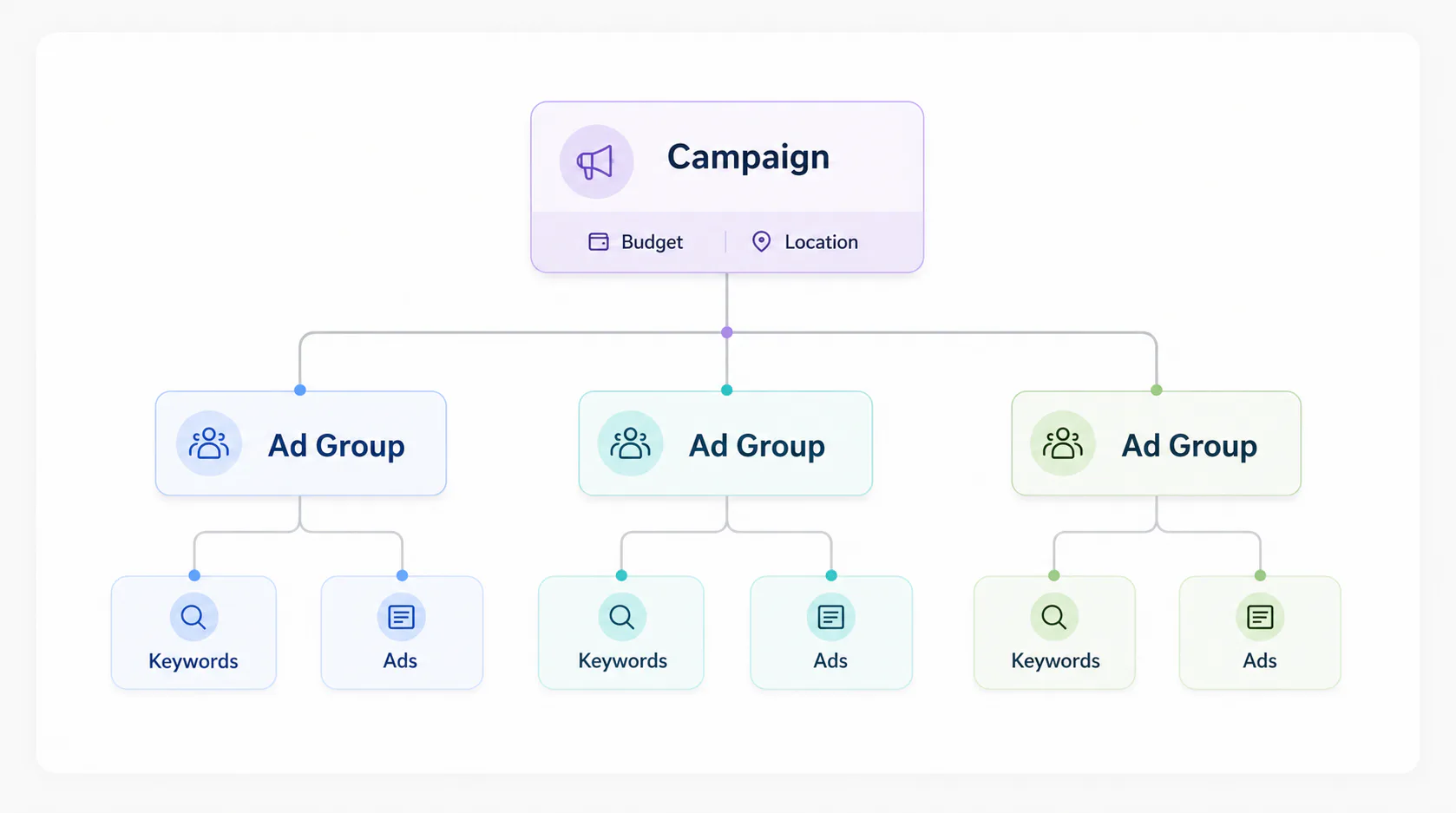
Google Ads is organised in layers: campaigns at the top (where you set budget and targeting), ad groups within those (where you cluster related keywords), and then the individual keywords and ads within each group. Getting this structure right from the start makes everything easier to manage and optimise later.
Start with your keywords
Keywords are the foundation of every paid search campaign. Get these right and everything else falls into place. Get them wrong, and you’ll spend money showing ads to people who were never going to buy from you.
The mistake most businesses make is going too broad. If you sell handmade furniture in Melbourne, bidding on the keyword “furniture” will put you in an auction against IKEA, Temple & Webster, and every other furniture retailer in the country. You’ll pay a premium for clicks from people who want a $50 bookshelf, not a $3,000 dining table.
Instead, focus on long-tail keywords: longer, more specific phrases that reflect genuine buying intent. “Custom timber dining table Melbourne” or “handmade furniture maker near me” will attract fewer clicks, but the people clicking are far more likely to become customers. Long-tail keywords are cheaper, less competitive, and convert at higher rates.
But before you start building keyword lists, there’s a more fundamental step that many businesses skip: checking whether the words you use to describe what you do are actually the words your customers use when they search.
We worked with a company that provides commercial waterproofing services. Internally, they called their core offering “membrane installation” and “substrate preparation.” That’s the technically correct language in their industry. But when we ran the keyword research, the data told a completely different story. The vast majority of people searching for this type of work were typing things like “waterproofing for flat roofs,” “building leak repair,” and “commercial waterproofing contractor.” Almost nobody outside the industry was searching for “membrane installation.”
If we’d built the campaign around the language the business used internally, the ads would have appeared for a tiny fraction of the available searches. The budget would have been spent on the handful of people who already knew the technical terminology, while missing everyone else.
This happens more often than you’d think, especially with technically complex services or products that can be described in multiple ways. A business that sells “remedial building solutions” might find that customers are actually searching for “how to fix cracks in concrete.” An IT company offering “managed endpoint security” might discover that their audience is searching for “business antivirus” or “cybersecurity for offices.”
The lesson is simple: don’t assume you know what people search for. Run the research first. Tools like Google Keyword Planner, Semrush, or even Google’s autocomplete suggestions will show you the actual language your potential customers use. Build your campaign around their words, not yours.
Use Google’s Keyword Planner to research volume and competition. Look for keywords that have enough search volume to be worth targeting but aren’t so competitive that you’ll be outbid by bigger spenders. And always add negative keywords to exclude searches you don’t want to appear for. If you sell new furniture, add “second hand,” “used,” and “cheap” as negatives. If you don’t offer delivery, add “delivery” as a negative. This alone can save you a significant chunk of wasted spend.
Write ads that match the search
Your ad needs to do one thing well: convince the searcher that you have what they’re looking for. That means your headline should echo their search query, your description should clearly state what you offer and why it’s relevant to them, and your call to action should tell them exactly what to do next.
Avoid vague headlines. “Quality Solutions for Your Business” tells the searcher nothing. “Custom Timber Dining Tables, Handmade in Melbourne” tells them exactly what they’ll find. Be specific about what you offer, where you are, and what makes you worth clicking on.
Write at least three or four ad variations for each ad group so Google can test which performs best. Change the headline angle, try different calls to action, and test different value propositions. One ad might lead with price (“Tables from $2,500”), another with quality (“Solid Hardwood, Built to Last”), another with convenience (“Free Design Consultation, Book Online”). Let the data tell you which message resonates.
Send them somewhere worth landing
This is where a huge number of campaigns fall apart. You write a great ad, you target the right keywords, someone clicks through, and they land on your homepage. Or worse, a page that has nothing to do with what the ad promised.
Your landing page needs to deliver on the specific promise your ad made. If your ad says “Free Quote on Custom Timber Tables,” the landing page should be about custom timber tables and have a prominent quote request form. Not your full product catalogue. Not your About page.
The page needs to load fast, especially on mobile. Google factors page speed into your Quality Score, and users will leave if it takes more than a few seconds. It needs to look professional and be easy to navigate. And it needs a clear, single call to action. Don’t give people six different things to click. Give them one thing to do, and make it obvious.
Managing and Improving Over Time
Launching a PPC campaign is not a set-and-forget exercise. The businesses that get the best results from paid search are the ones that check in regularly, read the data, and make adjustments.
The most important habit is reviewing your search terms report. This shows you the actual phrases people typed into Google before clicking your ad. You’ll often find surprises, searches you didn’t anticipate that are either valuable new keyword ideas or irrelevant traffic you need to exclude. Make this a weekly task, especially in the first few months.
Watch your cost per conversion, not just your cost per click. A keyword might have cheap clicks but never convert, while another keyword costs more per click but consistently delivers paying customers. Shift your budget toward what’s actually generating results, not what looks cheapest on the surface.
Adjust your bids by location and device if the data supports it. If 80% of your conversions come from mobile, make sure your mobile bids reflect that. If one suburb or region converts at twice the rate of another, allocate more budget there.
Google’s automated bidding strategies can help once you have enough conversion data (typically 30 or more conversions per month). Options like Target CPA (cost per acquisition) or Maximise Conversions use machine learning to adjust bids in real time. They’re not magic, and they still need oversight, but they can improve efficiency once the algorithm has enough data to work with.
And keep testing. Swap out ad copy that’s underperforming. Try new landing page layouts. Test different offers. The businesses that treat PPC as an ongoing process of refinement, rather than something they set up once, are the ones that see compounding returns over time.
When to Consider Getting Help
PPC is manageable in-house, but it does take time and attention. If you’re spending more than a couple of thousand dollars a month, or if you’re in a competitive industry where the cost of mistakes is high, it’s worth considering whether professional management would give you a better return than doing it yourself.
A good PPC agency or specialist should be transparent about what they’re doing, show you exactly where your money is going, and demonstrate measurable improvement over time. Be wary of anyone who won’t give you access to your own ad account, locks you into long contracts, or can’t clearly explain their strategy.
Whether you manage PPC in-house or work with a partner, the fundamentals are the same: target the right people, with the right message, at the right time, and send them to a page that makes it easy to take the next step.