Keyword research for SEO and PPC is the work of figuring out what your customers actually type into Google, then using those phrases to shape your content and your ads. Skip it, and you’re guessing with your budget.
Why Does Keyword Research Matter in Digital Marketing?
Keyword research is the process of finding and analysing the words and phrases people use in search engines, then matching those phrases to your content and ads. It works by giving you data on what’s searched, how often, by whom, and with what intent, so your marketing can meet real demand.
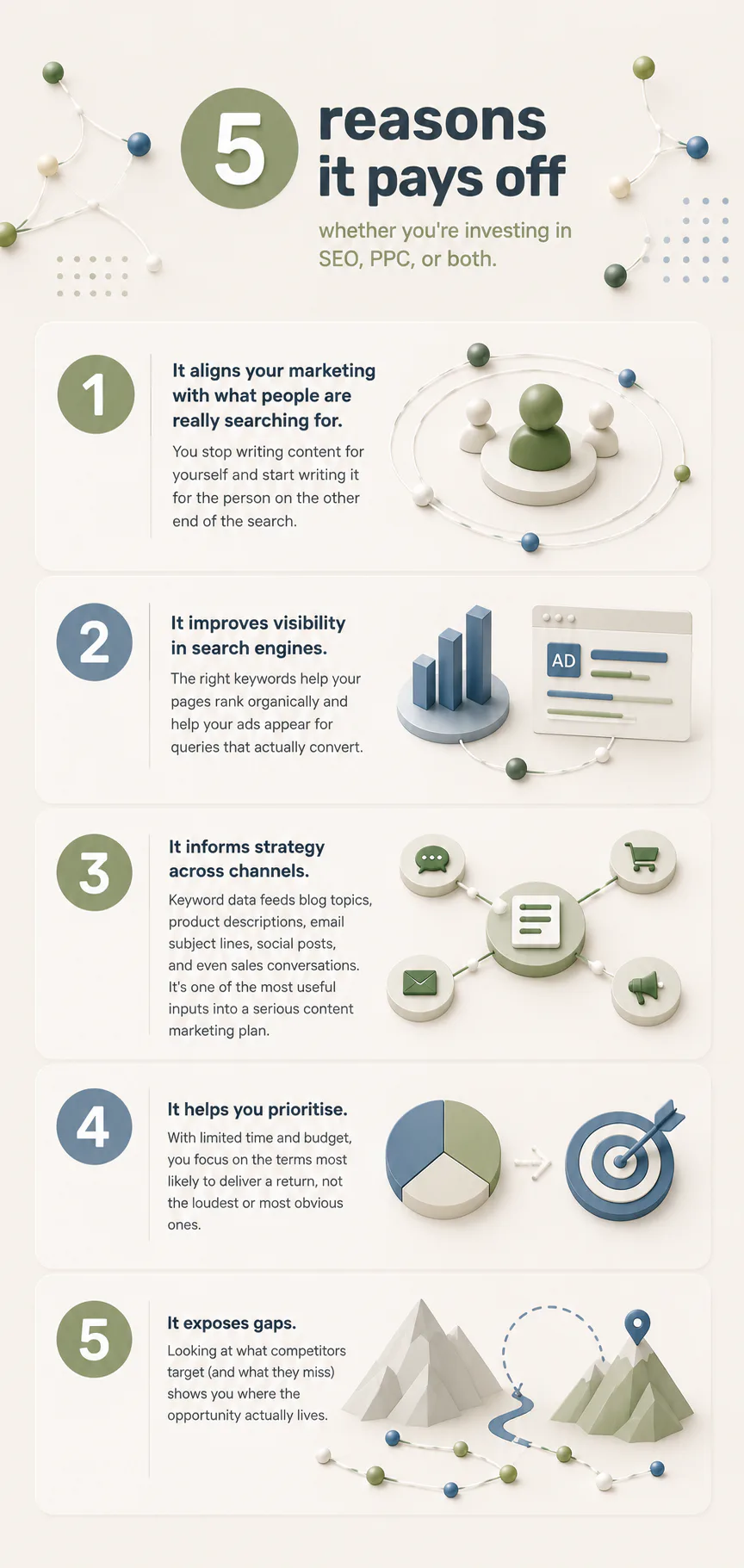
Five reasons it pays off, whether you’re investing in SEO, PPC, or both.
- It aligns your marketing with what people are really searching for. You stop writing content for yourself and start writing it for the person on the other end of the search bar.
- It improves visibility in search engines. The right keywords help your pages rank organically and help your ads appear for queries that actually convert.
- It informs strategy across channels. Keyword data feeds blog topics, product descriptions, email subject lines, social posts, and even sales conversations. It’s one of the most useful inputs into a serious content marketing plan.
- It helps you prioritise. With limited time and budget, you focus on the terms most likely to deliver a return, not the loudest or most obvious ones.
- It exposes gaps. Looking at what competitors target (and what they miss) shows you where the opportunity actually lives.
SEO and PPC: The Quick Definition
Before we go further, the two terms this guide keeps using.
Search engine optimisation (SEO) is the practice of improving your website so it ranks higher in unpaid search results. It works by combining content quality, site structure, and technical health, so search engines treat your pages as relevant and trustworthy. If you want a deeper look at how it fits into a broader strategy, our search engine optimisation service page covers it in more detail.
Pay-per-click advertising (PPC) is paid search. You bid on keywords, and your ad shows when someone searches them. You only pay when someone clicks. Google Ads is the most common platform, and it’s the backbone of most paid advertising campaigns we run.
Both rely on the same starting point. Knowing the keywords.
Understanding Keyword Types
Not all keywords behave the same way. The four big categories cover intent. The two structural ones cover length and competition.
By search intent
Informational keywords are searches for knowledge. “How to write a brief,” “what is a CMS,” “calories in eggs.” The user wants to learn, not buy.
Navigational keywords are searches for a specific site or brand. “Mettro contact,” “Australia Post tracking,” “ABC News.” The user knows where they want to go and is using search as a shortcut.
Commercial keywords sit in the middle of the buying journey. “Best CRM for small business,” “WordPress vs Squarespace.” The user is comparing options.
Transactional keywords signal readiness to act. “Buy,” “book,” “order,” “hire.” The user is ready to spend money.
By structure
Short-tail keywords are one or two words. High volume, high competition, broad intent. “Web design,” “marketing.”
Long-tail keywords are three or more words. Lower volume, lower competition, sharper intent. “Web design agency Brisbane,” “email marketing for small business.”
For most businesses, the long tail is where the real wins are. Less traffic, but better matched.
A few useful sub-types
Beyond intent and length, four labels are worth knowing.
Branded keywords contain your company or product name. They convert well because the searcher already knows you.
Generic keywords are non-branded category terms. “Bookkeeping services,” “running shoes.”
Niche keywords target a narrow segment with specific needs. “Vegan running shoes for flat feet.”
Geo-targeted keywords include a location. “Plumber Brisbane,” “cafe Fortitude Valley.” Critical for any business that serves a specific area.
Tools You Can Use
You don’t need expensive software to start. You do need at least one tool that gives you search volume and competition data.
Free tools
Google Keyword Planner is free with any Google Ads account. It gives keyword ideas, search volume ranges, and competition levels. It’s built for advertisers but useful for SEO too.
Google Search Console shows what’s already driving traffic to your site. It’s not a research tool in the strict sense, but it’s the best free source of data on what your real audience is finding you for.
Ubersuggest offers keyword suggestions, search volume, SEO difficulty, and content ideas. The free tier is limited but enough to get started.
Paid tools
Semrush gives detailed search volume, keyword difficulty, cost-per-click, and intent data through its Keyword Magic Tool. Strong for both campaign planning and competitor analysis.
Ahrefs is built around backlink and keyword research, with difficulty scores, traffic potential, and SERP previews. Particularly good at surfacing content gaps.
If you’re doing this seriously, expect to invest in one paid tool. The data depth is worth the subscription.
How to Do Keyword Research for SEO and PPC, Step by Step
Six steps. In order. Don’t skip any.
Step 1: Set your goal
Before opening a tool, write down what you’re trying to do. Goals shape every keyword decision that follows.
For SEO, the goal is usually long-term organic visibility. You want pages that rank for relevant terms, attract qualified traffic, and build authority over months and years. Keywords here support blog content, service pages, and educational resources.
For PPC, the goal is immediate, measurable action. Clicks, leads, sales, demos booked. Keywords here need to match high intent and justify their cost-per-click.
Also, think about your ideal customer. Where are they? What do they know? Are they researching, comparing, or ready to buy? You can’t pick the right keywords until you’ve pictured the right person.
Step 2: Build a seed list
A seed list is the small, hand-picked set of keywords you’ll expand from. Three sources to draw on.
Your core offerings. The products, services, and solutions you actually provide. If you sell eco-friendly water bottles, that phrase goes on the list. So does your category, “reusable water bottles.”
Your brand and product names. Anything someone might type if they already know you, or might come close to typing.
Your customers’ problems and questions. What pain points do you solve? What questions do you hear on sales calls? Phrases like “how to fix a leaky tap” or “best way to save energy at home” mirror how a real person describes the problem.
Aim for 15 to 30 seed keywords. The tools will help you grow that into hundreds.
Step 3: Analyse the metrics
For every candidate keyword, look at three numbers.
Search volume. How often the term is searched, usually shown as a monthly average. Higher means more potential traffic, but not always more value.
Competition or keyword difficulty. How hard it is to rank organically (SEO) or how expensive it is to bid (PPC). SEO tools score difficulty out of 100. Google Keyword Planner labels PPC competition as low, medium, or high.
Intent. Match each keyword to one of the four intent categories above. Intent tells you what the searcher actually wants, and whether your page or ad can deliver it.
A keyword with 50,000 monthly searches and a 90 difficulty score isn’t useful if you can’t realistically rank for it. A keyword with 200 searches and clear transactional intent might be worth more than ten high-volume informational ones.
Step 4: Prioritise based on relevance and feasibility
Now narrow the list. The shortlist should pass three tests.
It’s relevant. The keyword closely matches what you sell or what your audience cares about. If it’s a stretch, drop it.
It’s achievable. For SEO, you can realistically rank in the top 10 with the resources you have. For PPC, the cost-per-click fits your budget and your conversion economics.
The intent matches your goal. If you want awareness, prioritise informational and commercial terms. If you want conversions, prioritise transactional terms.
A good shortlist for a single campaign or content cluster is usually 10 to 20 keywords, grouped by theme.
Step 5: Apply the keywords
Research is only useful if it lands somewhere. Two playbooks, one for SEO and one for PPC.
On-page SEO. For each target page, choose one primary keyword and two or three closely related ones. Place the primary keyword in the title tag (under 60 characters, near the front), the meta description, the H1, at least one H2, and naturally through the body. Use related phrases and synonyms to support context. Don’t repeat the same keyword over and over. Search engines have been past that for years, and readers find it grating.
PPC campaign structure. Group keywords by tight themes, one theme per ad group. Write ad copy that uses the keyword in the headline and matches its intent. Send clicks to a landing page that mirrors the ad’s promise.
A worked example.
Ad group: Bookkeeping Brisbane Keywords: “bookkeeping services Brisbane,” “hire bookkeeper Brisbane” Ad headline: “Bookkeeper in Brisbane? Local, qualified, no surprises.” Landing page: Bookkeeping service page with pricing, contact form, and Brisbane credentials.
Tight grouping like this lifts ad relevance, lowers cost-per-click, and pushes conversion rates up.
Step 6: Monitor and adjust
Keyword performance shifts. New competitors enter, search habits change, and your own content matures. Build a review rhythm.
For SEO, check Google Search Console monthly. Track impressions, clicks, average position, and which pages are ranking for which terms. Refresh slipping pages. Add sections that target emerging long-tail variations.
For PPC, review your Google Ads reports weekly at first, then monthly once campaigns stabilise. Watch impressions, clicks, conversions, and cost-per-conversion. Test ad copy variations. Test match types (broad, phrase, exact). Add irrelevant queries to your negative keyword list so you stop paying for clicks that don’t fit.
The work doesn’t end. Keyword research is part of an ongoing optimisation cycle, not a one-off project.
Common Keyword Research Mistakes
A few traps that catch beginners.
Chasing volume over relevance. A keyword with 100,000 searches is useless if 99% of those searchers will never become your customers.
Ignoring intent. “Free CRM” and “best CRM software” sound similar. They aren’t. One searcher won’t pay for anything. The other is ready to buy.
Targeting only short-tail keywords. They’re competitive and expensive, and the long tail is where most of the qualified traffic actually sits.
Setting and forgetting. Performance data is the point. If you’re not watching it, you’re not really doing keyword research, you’re just doing keyword guessing once.
Your Next Step
Keyword research for SEO and PPC isn’t complicated, but it does take time and a clear head. Set a goal. Build a seed list. Check the metrics. Prioritise. Apply. Monitor. Repeat.
If you’d rather have someone do this with you, or take it off your plate entirely, that’s the work we do every day at Mettro. We help businesses figure out what their customers are actually searching for, and we turn that into SEO and paid advertising that earns its keep.
Let’s talk about your SEO and PPC.