Most businesses don’t need to pick a side. They need to know what each channel does, what it costs, and when each one pulls its weight. That is the real question behind “SEO vs PPC”, and it has a more useful answer than “it depends”.
Your search strategy decides whether new customers find you when they’re ready to spend. The businesses doing this well have a steady stream of organic traffic and the ability to turn paid volume on when they need it. The ones who haven’t worked it out are either invisible or burning budget on clicks that go nowhere.
SEO and PPC at a Glance
Search Engine Optimisation (SEO) is the practice of improving your website so it ranks higher in unpaid search results. It works by making your site more relevant, more authoritative and easier for search engines to read.
Pay-per-click (PPC) is paid advertising. Your ad appears in search results, on social platforms or across the web, and you pay each time someone clicks it.
How Does SEO Actually Work?
Search engines run on three things. They crawl the web, index what they find, and rank pages against each search query. SEO is the work that makes your site visible at each stage.
Crawling and indexing. Search engines send bots to read pages and store them in an index. If your site is hard to crawl, broken or slow, your pages may never make it in. SEO at this stage means logical site structure, clean internal links, a working sitemap, fast load times and a mobile-friendly build.
Matching queries to pages. When someone searches, the engine scans its index for pages that match the words used and the intent behind them. “Cheap office chairs Brisbane” and “best ergonomic office chair under $500” pull different results for a reason. SEO here is about writing the way your audience searches, with clear headings, useful answers and sensible metadata.
Ranking on relevance and trust. Search engines weigh hundreds of signals, including content quality, backlinks from credible sites, page experience and how users behave once they land. Strong content earns links. Good user experience keeps people on the page. Both feed back into rankings over time.
What SEO Actually Involves
SEO splits into three areas. Each does a different job.
On-page SEO is everything you do on your own website. Content quality, keyword usage, page titles, meta descriptions, headings, internal links, image alt text, URL structure. The goal is to make each page clear to both users and search engines.
Off-page SEO builds your reputation. Backlinks from credible sites, brand mentions, social signals and guest content all tell search engines that other people consider your site worth referencing. Trust is earned, not declared.
Technical SEO keeps the engine running. Site speed, mobile responsiveness, crawlability, indexing, structured data, canonical tags and HTTPS. Without it, the best content in your industry can still go undiscovered.
Why Does SEO Matter for Your Business?
The short answer is that SEO benefits stack up. The longer answer covers a few specifics.
Organic traffic costs nothing per click. Once your pages rank, the visits keep coming without an ad budget propping them up. Users also trust organic results more than ads, so a top-three ranking carries credibility that paid placements don’t.
Good SEO is good UX. The work that makes search engines happy, structure, speed, and mobile design, also makes the site better for customers. And it catches users at every stage of the buying process, from “what is this thing” to “who’s the best at it near me”.
Local visibility matters. For Queensland businesses, ranking for location-based searches puts you on the map literally and figuratively. Map listings, local packs and “near me” results drive real foot traffic and enquiries.
The payoff lasts. A well-optimised page can rank for years, bringing in visitors long after the work is done.
Where SEO Has Limits
SEO is patient work. It usually takes three to six months before results show, and competitive industries can take longer. Algorithms change, too, and even well-built sites can move up or down when Google updates its ranking systems.
Nothing is guaranteed. SEO improves your chances of ranking, but it does not promise a top spot. And it is not free. There is no cost per click, but there is real cost in time, expertise and content. Done properly, SEO is an investment that needs maintenance to stay competitive.
How Does PPC Actually Work?
PPC is faster, more transparent and more controllable than SEO.
You choose keywords your customers are likely to search for, then set a bid for how much you will pay per click on each one. When someone searches, an automated auction runs. The search engine weighs your bid, your ad’s relevance, your expected click-through rate and the quality of your landing page. Better-performing ads can win the auction at lower bids than weaker ones.
Winning ads appear above and below the organic results, marked as sponsored. You pay when someone clicks, with daily budgets and maximum bids keeping spend in check. Every click, conversion, cost per click and return on ad spend is trackable, which tells you what to keep, what to cut and what to test.
Why Does PPC Matter for Your Business?
PPC earns its keep when speed and control matter.
Visibility is immediate. Launch a campaign in the morning, and get traffic by the afternoon. Targeting is precise, too. Location, device, time of day, audience interests, and specific search terms. You decide who sees your ad and when.
Budget is yours to control. Set a daily cap, pause campaigns, scale up or down. Performance is measurable in real time, which makes it easier to defend the spend and adjust the strategy.
Where PPC Has Limits
The costs add up. You pay for every click, whether it converts or not. In competitive industries like real estate, legal or finance, cost per click can be steep. Campaigns need attention, too. PPC is not set-and-forget. Bids, audiences, ad copy and landing pages all need regular review.
The traffic stops when the spending stops. Pause your campaign, and your ads vanish. Not every click is a customer, either. Some are bots, some are competitors, some are casual browsers. Good targeting and exclusions help, but waste is part of the game. Some users skip ads entirely and scroll straight to organic results.
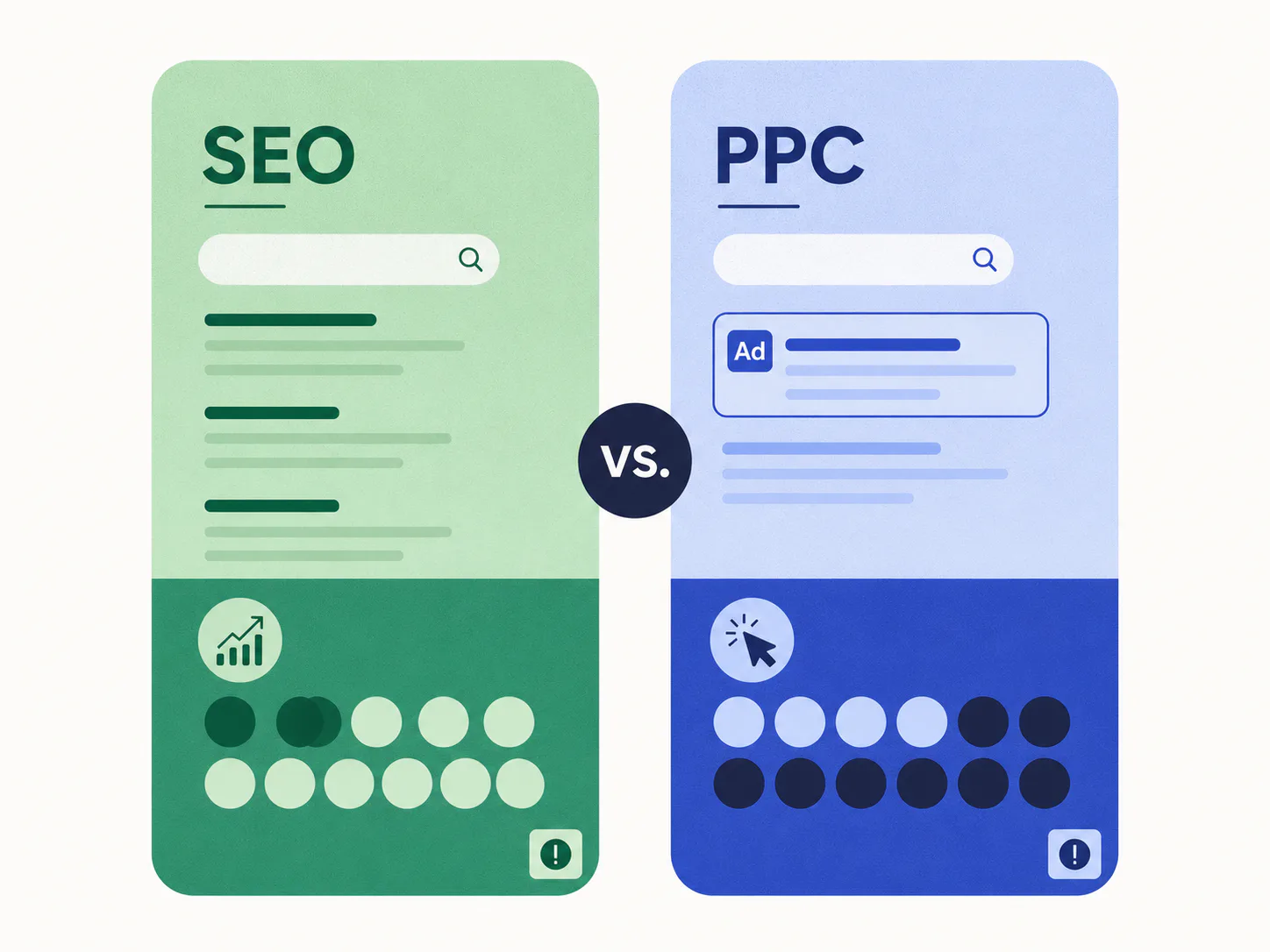
SEO vs PPC: Side-by-Side
| Factor | SEO | PPC |
|---|---|---|
| Cost model | Time, expertise and content investment | Pay per click |
| Speed of results | Months to build momentum | Immediate once live |
| Trust factor | High, users prefer organic results | Lower, some users skip ads |
| Control over visibility | Indirect, depends on ranking | Direct, you choose placement |
| Targeting precision | Broad, based on search intent | Precise, by audience and behaviour |
| Best for | Long-term growth, brand authority | Launches, promotions, lead generation |
| What happens if you stop | Traffic continues for a while | Visibility stops immediately |
When Should You Use SEO?
Lean into SEO when you are building for the long term.
You want sustainable visibility without an ongoing click bill. Organic rankings keep working long after the page is published, and you reach early-stage searchers, the people researching, comparing and learning before they are ready to buy.
You can wait three to six months for results. If the business needs traffic this week, SEO alone will not deliver it.
You want to build authority. Strong organic rankings position you as credible in your industry, which matters for considered purchases in healthcare, finance, professional services, property and similar sectors. Local visibility helps too. Mettro works with Queensland businesses across retail, healthcare, government, property and tourism, and local SEO consistently drives genuine enquiries from people nearby.
When Should You Use PPC?
PPC earns its place when speed, targeting or testing matter most.
You need traffic now. New product launches, time-limited offers, event promotions or a sudden gap in lead flow. You want to target a specific audience by geography, device, time of day or interests, putting your offer in front of the exact people who should see it.
You are testing a message or offer. PPC is a fast, cheap way to find out which headlines, CTAs and landing pages convert. It also gives you a way into high-competition categories where organic rankings are hard to crack. Paid advertising gets you above competitors who have spent years building their SEO, and it gives you a measurable, controllable lead flow you can turn up or down.
When Should You Use Both?
For most businesses we work with, the answer is both. The two channels do different jobs, and the combination usually outperforms either one alone.
You cover every stage of buying intent. SEO catches the researchers, PPC catches the ready-to-buy. The same person might find you organically on Tuesday and click an ad on Friday. You also balance short-term and long-term goals. PPC delivers leads now while SEO builds the asset that pays off later.
You compete more effectively in busy categories. Owning both paid and organic real estate on a search results page pushes competitors further down and gives you two chances to win the click. And you learn faster. PPC data tells you which keywords convert, which messages work and which audiences respond. That intelligence feeds straight back into your SEO strategy.
Industries where the both-and approach earns its keep include healthcare, professional services, retail, building and trades, education and not-for-profit. The exact split depends on margins, sales cycle and competition.
SEO vs. PPC: How to Decide What You Need
Before picking a channel, answer four questions.
What is your timeline? If you need results this month, PPC has to be in the mix. If you can plan twelve months out, SEO becomes the better long-term bet.
What is your budget? PPC needs media spend on top of management costs while SEO needs investment in content, technical work and ongoing optimisation. Both cost money. They cost it differently.
How competitive is your market? In crowded categories, organic results are slower to win and paid clicks cost more. You may need both to compete at all. And what does your sales cycle look like? Considered purchases benefit from SEO’s authority-building. Quick decisions and seasonal offers lean toward PPC.
If you are unsure, a digital strategy session is a sensible starting point.
Your next move depends on where you are now. If your organic traffic is flat or your paid campaigns are leaking budget, the issue is usually strategy, not effort.
Let’s talk about your search strategy