Google Ads and PPC are not the same thing, though plenty of people use the terms interchangeably. Google Ads is one platform. PPC is a pricing model that lots of platforms use, Google included.
The distinction sounds pedantic. It isn’t. It changes how you choose where to advertise, how you read a proposal from an agency, and what you should reasonably expect from anyone running paid campaigns on your behalf. Get it wrong, and you can end up running what you think is a “PPC strategy” but is really just a Google search campaign with everything else missing.
Here is what each one actually is, how they fit together, and what to look for when you are spending money on either.
What Is PPC?
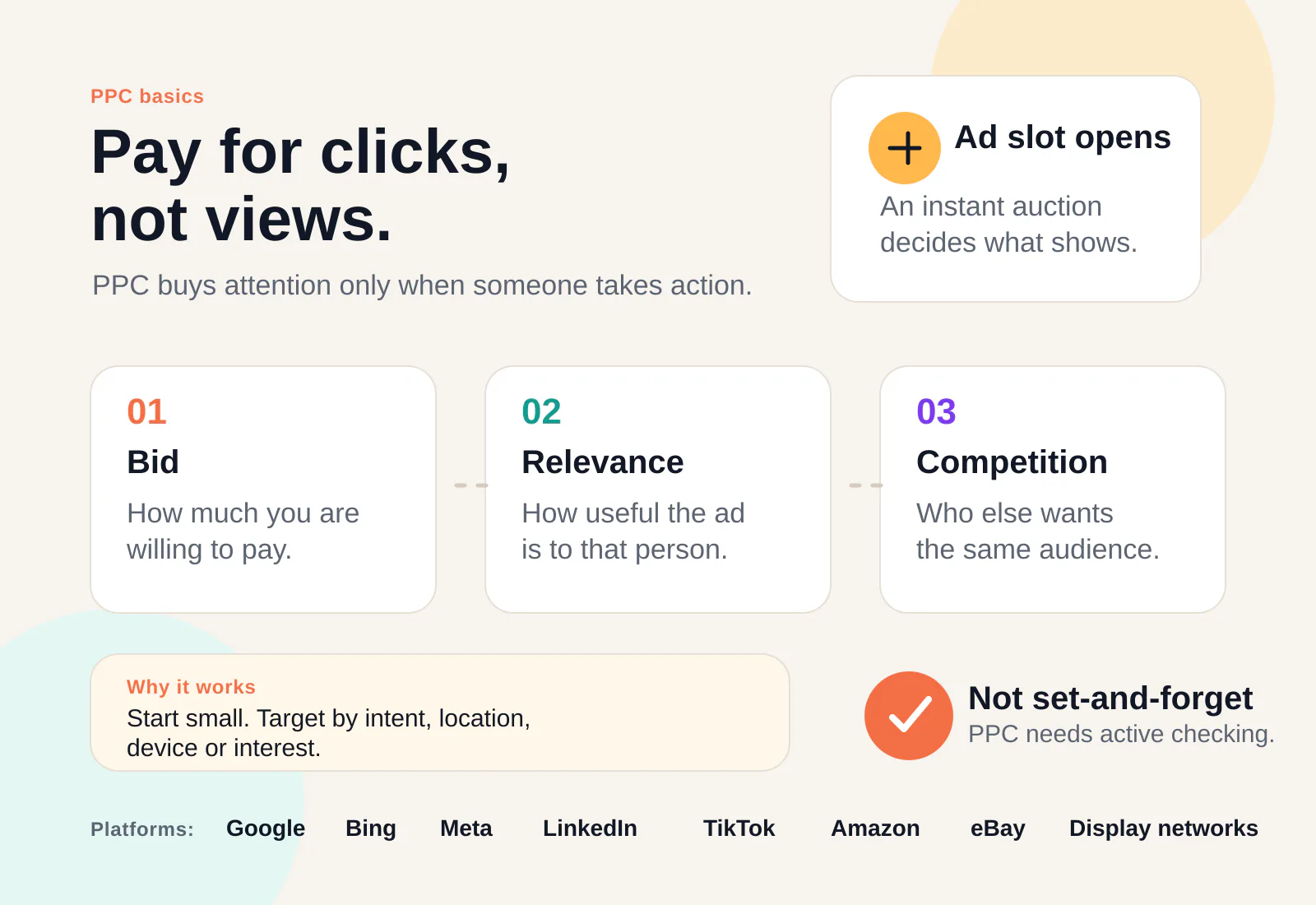
PPC (pay-per-click) is an ad-buying model where you pay only when someone clicks your ad, not when it is shown. It works by running an auction every time an ad slot is available. Your bid, your ad’s relevance, and how much competition there is for the same audience all feed in.
The PPC model runs across most of the digital ad world. Search engines like Google and Microsoft Bing, and social platforms like Meta, LinkedIn, X and TikTok use it. So do marketplaces like Amazon and eBay, and display and native networks like Taboola, Outbrain and AdRoll. Almost any platform where you can target an audience and pay for clicks is, in some form, a PPC platform.
A few things make PPC genuinely useful for businesses. You can start small and scale up only when something is working. You can target by intent, location, device, demographics or interest. Someone searching for “emergency plumber Brisbane” is in a very different state of mind from someone scrolling Instagram on a Sunday afternoon, and PPC lets you treat them differently. You can also switch a campaign off the moment it stops paying its way.
The flip side is that PPC requires attention. Set-and-forget is the fastest way to spend money for nothing.
What Is Google Ads?
Google Ads is Google’s advertising platform. It puts your ads in front of people across Google’s own properties and partner sites, including the search results page, YouTube, Gmail, the Discover feed, Maps, and millions of websites in the Google Display Network. Most businesses running paid advertising in Australia have at least some of their spend going through it.
Most ads inside Google Ads are bought on a PPC basis, which is where the confusion starts. Some are not. Video views on YouTube can be charged per view (CPV). Display placements are often charged per thousand impressions (CPM). Performance Max campaigns optimise toward whatever conversion event you tell them to. So when someone says “we run PPC for clients,” they usually mean Google Ads, but not all of what runs inside Google Ads is technically PPC.
Worth knowing what Google Ads can actually do, because the platform has gotten broader over the years.
- Search ads are the text ads at the top of Google search results, triggered by what someone types
- Shopping ads sit alongside them, showing product images, prices and stock status pulled from your product feed
- Display ads run on third-party websites that sell ad space through Google
- Video ads run on YouTube in skippable, non-skippable and bumper formats
- App ads promote mobile apps across Google properties
- Performance Max is the all-in-one campaign type that runs across every Google surface, using machine learning to decide where your money goes
- Demand Gen does similar work on YouTube and Discover with a focus on visual creative
Each of those is a different lever. Mixing them well is part of what running Google Ads properly involves.
How Google Ads and PPC Fit Together
If PPC is the model and Google Ads is the platform, the relationship is set-and-subset. Google Ads is one PPC platform. There are many others. Microsoft Advertising runs the same way on Bing, Yahoo and DuckDuckGo. Meta Ads runs across Facebook, Instagram, Messenger and WhatsApp. LinkedIn Ads, X Ads, TikTok Ads, Amazon Ads, Reddit Ads. All PPC, none of them Google.
The reason the terms get used interchangeably is that Google Ads dominates. Google holds roughly 90% of the global search market according to Statcounter (2025), which means most paid search money ends up there by default. When most of the industry’s PPC spend flows through one platform, calling that platform “PPC” feels close enough.
Close enough is not the same as the same. The minute you bring in a second platform, the distinction matters. A Meta campaign optimises, costs, and converts differently. An Amazon Ads campaign answers to Amazon’s logic, not Google’s. A LinkedIn campaign costs more per click than almost any other platform, but reaches B2B decision-makers like nothing else can.
If your “PPC strategy” is Google Ads only, you do not have a PPC strategy. You have a Google Ads strategy. That might be the right call for your business. Just call it what it is.
Why Does the Difference Matter for Your Business?
Three reasons it matters more than it sounds.
You can pick the right platform for the job rather than defaulting to Google because everyone says “we need PPC”. Google search is brilliant for capturing demand from people who already know what they want. It is much weaker for creating demand among people who have not gone looking yet. If you are launching something new, selling on aesthetics, or building brand recognition with a younger audience, Meta or TikTok will likely outperform a search campaign, even though both are PPC.
You can read a proposal properly. When an agency or consultant says they will “run your PPC”, ask which platforms, which campaign types, and how the budget is split. If they cannot answer cleanly, the strategy is probably “Google search ads, and we will tell you it is working”.
You can hold the work to account. Different platforms produce different metrics. If you are comparing a YouTube view-through to a Google search click, you are not comparing like for like. Knowing what is PPC, what is CPM, what is CPV, and what is a conversion-optimised auction tells you whether the numbers in the report mean what they look like they mean.
This is the kind of thinking that should sit behind any paid advertising decision. Pick the platform that fits the job, not the one with the most familiar name.
How Do You Measure Google Ads and PPC Performance?
The metrics that matter depend on what you are trying to achieve, but a handful show up in nearly every campaign worth running.
Click-through rate (CTR) is the percentage of people who saw the ad and clicked. A higher CTR usually means your message is matched to your audience. A low CTR often means the targeting or the ad itself needs work, not that the platform is broken.
Conversion rate is the percentage of clicks that turned into something you actually wanted. A purchase, a phone call, a form submission, a booked demo. Clicks without conversions are just expensive traffic.
Cost per click (CPC) is what you pay on average for each click. Useful as a directional number, less useful in isolation. A $40 CPC on LinkedIn for a B2B audience can be cheaper, in real terms, than a $2 CPC on Google search for an audience that does not buy.
Cost per acquisition (CPA) is what it costs you, on average, to get one of those conversions. This is the number most decisions should turn on. If your CPA is below what a customer is worth to you, the campaign is paying for itself. If it is above, something needs to change.
Return on ad spend (ROAS) flips that around. It tells you how much revenue you get for every dollar spent. A ROAS of 4 means $4 in revenue for every $1 in ad spend. Useful for ecommerce, less useful for service businesses where revenue lands months after the click.
Quality Score is Google Ads-specific. It is Google’s rating of how relevant your keywords, ads and landing pages are to each other and to the searcher. Better Quality Scores get you cheaper clicks and better positions. A signal worth watching, not a number to obsess over.
Impressions by themselves do not mean much for response advertising. They matter more when the goal is being seen at all, like brand awareness work.
The metrics are only as good as what you do with them. Too many businesses set up Google Ads, leave conversion tracking half-finished, and then judge campaigns on clicks. That is a fast way to spend money you cannot account for.
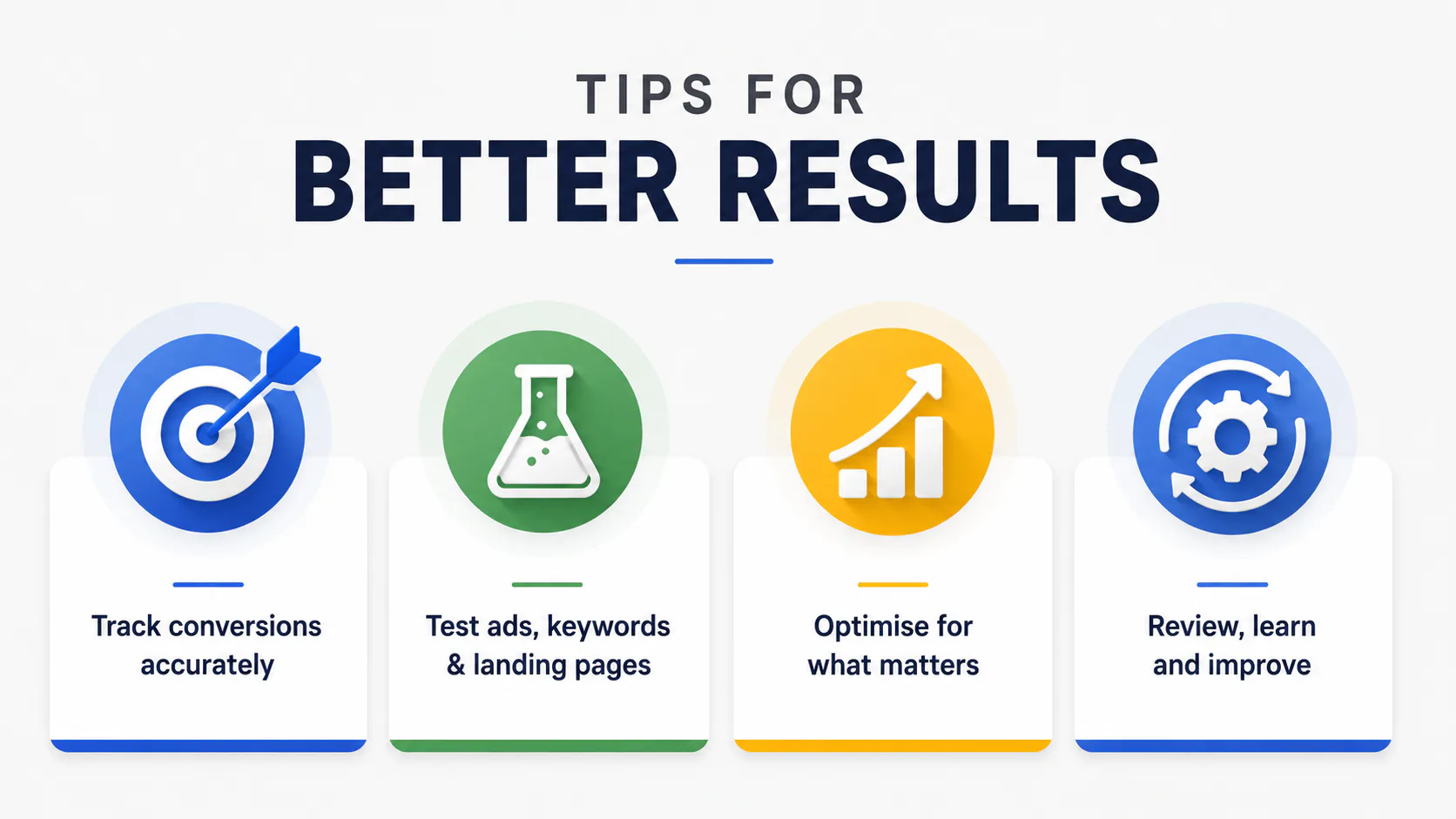
Decide what counts as success before you launch, not after the campaign has been running for a month. Set up enhanced or server-side conversion tracking so the numbers survive iOS privacy updates and ad blockers. Review weekly during the first month, then move to monthly once you have a baseline. Test one variable at a time when you are optimising, not three at once. Keep a record of what you changed and when, because the difference between a good campaign and a bad one is usually one decision made six weeks ago that you no longer remember.
That is enough to keep most campaigns honest. The deeper work sits with proper data analytics and conversion tracking, but the basics will get you most of the way.
Where to From Here
Where your next ad dollar goes should follow your objective. Start with what you want a customer to do, then find the platform that does it most efficiently. Not sure where that is? Talk to us, we’ll tell you straight. Let’s talk paid advertising.