PPC for small businesses works when you treat it as a system, not a switch. Set a clear goal, pick the right platform, write ads that match what people are actually looking for, and send the click somewhere worth landing. Skip any of those, and you’re paying Google or Meta to teach you a lesson.
This guide walks through what PPC is, where it runs, the terms you’ll keep bumping into, and the strategy that turns ad spend into customers. It’s written for small business owners who are weighing up whether to run ads themselves or bring in help.
What is PPC Advertising?
Pay-per-click (PPC) advertising is an online ad model where you pay a fee each time someone clicks your ad. It works by buying visits rather than earning them through organic search or social.
The point is to put your ad in front of the right person at the right moment. That might be when they’re searching for what you sell, reading something related, or scrolling their feed. The platform shows the ad. They click. You pay.
That’s the mechanic. The strategy is harder.
Does PPC Work for a Small Business?
Yes, when it’s set up well. The appeal for small business is real. Ads can be live within hours rather than months, and you decide exactly who sees them, whether that’s by location, search intent, interests or behaviour. Budgets are yours to control day by day, and campaigns can be paused or scaled at any time. Every click, impression and conversion is trackable, so you know what your money is actually doing. And even when people don’t click, seeing the ad still builds recognition over time.
The reasons PPC for small businesses fail are quieter and worth knowing. Vague goals. The wrong platform for the audience. Landing pages that don’t match the ad. Budgets are stretched too thin across too many places. We’ll cover all of that.
How Does PPC Work?
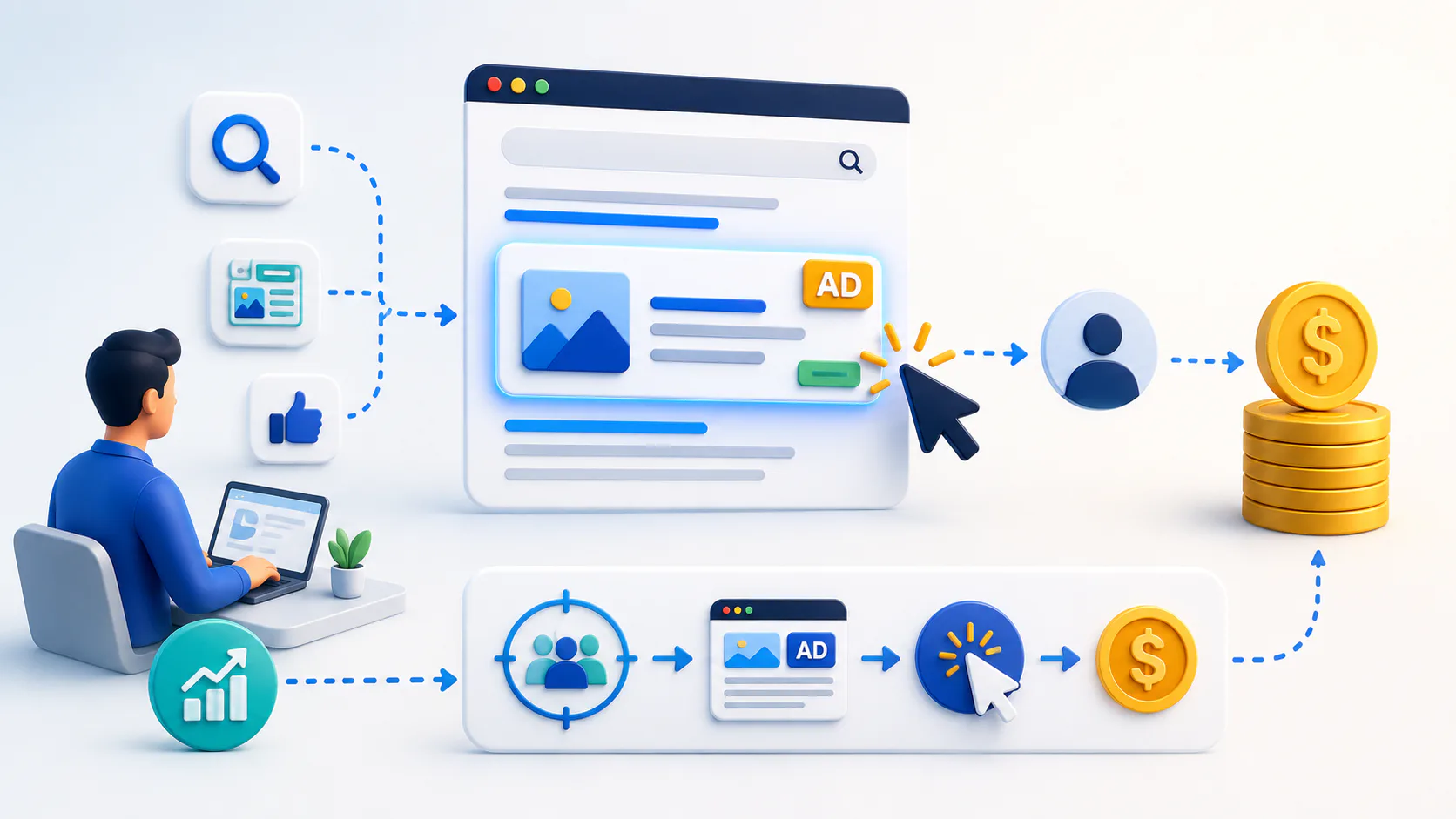
You place an ad on a platform like Google or Meta and pay only when someone clicks. Underneath that simple sentence sit five steps.
- Create the ad. Text, image, or video, depending on the platform.
- Bid on keywords or audiences. On Google or Microsoft Ads, you choose search terms. On Meta, TikTok or LinkedIn, you choose audience traits.
- The auction runs. When someone searches your keyword or fits your audience, the platform decides which ads to show. If you win, your ad appears.
- You pay on click. The actual cost per click (CPC) is often less than your maximum bid.
- They land on your page. Where they either take action or leave.
After that, you track, learn, and tighten. The campaigns that work are the ones that get adjusted.
Where Can You Run PPC Ads?
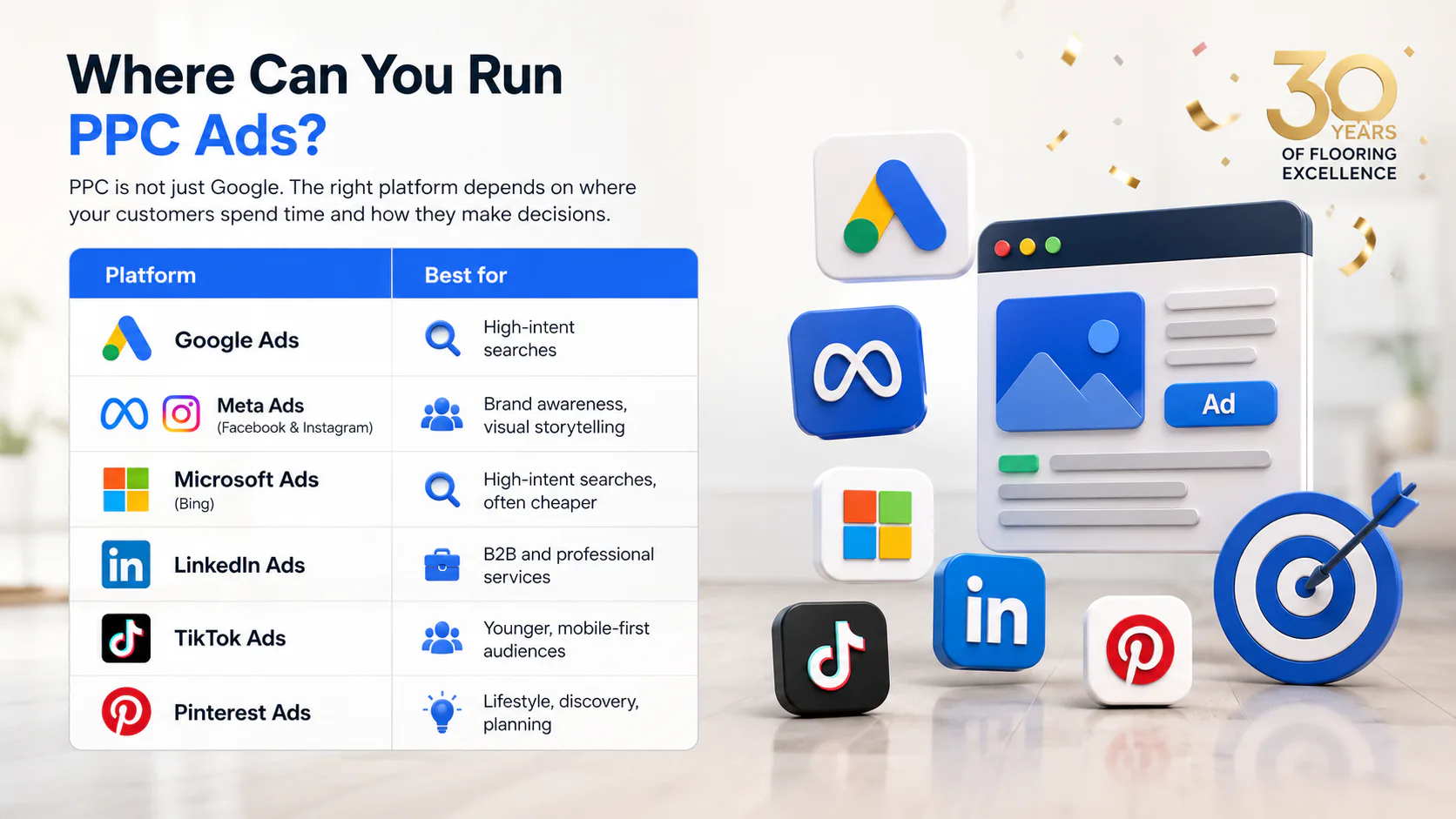
PPC is not just Google. The right platform depends on where your customers spend time and how they make decisions.
| Platform | Best for | Ad types | Targeting |
|---|---|---|---|
| Google Ads | High-intent searches | Text, shopping, display | Keywords, location, device |
| Meta (Facebook & Instagram) | Brand awareness, visual storytelling | Image, video, carousel | Interests, behaviours, demographics |
| Microsoft Advertising (Bing) | High-intent searches, often cheaper | Text, shopping | Keywords, demographics |
| LinkedIn Ads | B2B and professional services | Sponsored posts, InMail, display | Job title, industry, seniority |
| TikTok Ads | Younger, mobile-first audiences | Short-form video | Interests, behaviours, location |
| Pinterest Ads | Lifestyle, discovery, planning | Promoted pins | Keywords, interests, life events |
Most small businesses we work with start on one platform. Google Ads if customers are searching. Meta if they’re scrolling. Trying to run everything on day one is the fastest way to spend a lot and learn nothing.
The PPC Terms You’ll Actually Use
Skim this once and come back when something looks unfamiliar.
Keywords are the words and phrases people type into search engines. Short-tail keywords are broad and competitive (“photographer”). Long-tail keywords are specific and convert better (“affordable wedding photographer Brisbane”). Negative keywords are terms you exclude so your ad doesn’t show for irrelevant searches, like a bakery blocking “bakery jobs”.
Ad copy is the text or visuals in the ad itself. The headline does most of the work.
Call to action (CTA) is the prompt that tells the reader what to do next. Book now. Get a quote. Shop today.
Bidding is the auction system you enter. You set a maximum you’re willing to pay for a click. The platform decides what you actually pay.
Cost per click (CPC) is what you pay when someone clicks. It varies by industry, competition and ad quality.
Impressions are how many times your ad showed. Impression share is how often it showed compared to how often it was eligible. A low share usually means your bid or budget is too low.
Click-through rate (CTR) is the percentage of people who saw the ad and clicked. Higher CTR usually means the ad is relevant.
Quality Score (Google’s version) rates your ad, keyword and landing page from 1 to 10. Higher scores cost less and rank better.
Landing page is where the click takes them. It should match the ad’s promise.
Conversion is the action you want, whether that’s a form submission, sale, booking or call.
Retargeting shows ads to people who’ve already visited your site or interacted with your brand. Useful for nudging people who didn’t convert the first time.
Strategies That Make PPC for Small Businesses Actually Work
Good PPC is mostly about making the same handful of decisions well. Here are the ones that matter most.
Start with a clear goal
Pick one goal, not three. You’re either chasing awareness (showing up where your audience already spends time), leads (form fills, calls, enquiries), or sales (purchases, bookings, signups). Campaigns that try to do all three usually do none of them well.
Then decide how you’ll measure it. Cost per lead, conversion rate, return on ad spend. If you can’t say what success looks like as a number, you’re not ready to run ads.
Know who you’re trying to reach
Demographics matter, but they’re not the whole story. The questions worth answering go deeper. What problem are your customers actually trying to solve? What pushes them from “thinking about it” to “doing something about it”? Where do they spend time online, and what kind of message tends to land with them?
Your platform, your copy, your targeting and your offer all flow from that. Skip this part, and the rest of the campaign is guesswork dressed up as strategy.
Choose keywords carefully
Good keywords bring qualified traffic. Bad ones burn money. Use Google Keyword Planner or Semrush to find terms with real search volume. Lean toward long-tail keywords when you’re starting out. They’re cheaper, less competitive, and the people searching them are usually closer to buying.
Write ads that talk to a person
Be direct. Lead with the benefit, not the brand. Make the description do real work. End with a clear next step. The best small business ads sound like a useful answer, not a billboard.
Match the landing page to the ad
This is where most campaigns leak. The click is the easy part. The page has to deliver.
Keep it relevant. The page should reflect the ad’s promise word-for-word where possible. Make it fast. Make it mobile-friendly. Strip it back to one primary action.
Pick the right platform for the job
The right platform comes down to how your customers behave. If they’re actively searching for what you offer, Google Ads or Microsoft Ads are where you want to be. Audiences who browse and discover rather than search tend to convert better on Meta, TikTok and Pinterest. For B2B and decision-makers, LinkedIn is usually worth the higher cost per click.
Budget shapes the choice too. Google and LinkedIn run hot. Microsoft is a quieter, often cheaper alternative to Google. Meta and TikTok stretch smaller budgets further, especially when the creative is strong.
You don’t need to be everywhere. Start where your audience is most likely to take action and where your offer fits the format. In our experience, the small businesses that get traction tend to begin with one platform, prove it works, then expand. A common path is Google for direct leads first, Meta layered in later for awareness and retargeting.
Set a budget you can actually sustain
PPC works on consistency, not bursts. Start with a number you can run for at least 90 days while you learn what works. Some industries (legal, finance, trades in major cities) carry a higher cost per click, so build that into the plan.
Use negative keywords to protect the budget. If you sell paid services, exclude “free” and “DIY”. If you don’t hire, exclude “jobs”. You’ll stop paying for clicks that were never going to convert.
Track, then tighten
Watch the metrics that map to your goal. Click-through rate. Conversion rate. Cost per acquisition. Run small A/B tests on headlines, CTAs and landing pages. Pause what’s not working. Move spend to what is. The campaigns that compound are the ones that get adjusted every week, not every quarter.
Why Does PPC Fail for Some Small Businesses?
In our experience, it’s almost never the platform’s fault. The pattern looks like this:
- The goal was vague, so success was unmeasurable.
- The landing page didn’t match the ad.
- The budget was spread across too many platforms.
- Nobody adjusted anything for three months.
- Negative keywords were never set up.
All of these are fixable once you know to look for them.
Six Questions to Ask Before You Spend
Before you launch anything, run through these, so you make the most of your PPC ad campaigns.
- What are you trying to achieve right now? Sales, leads, awareness, a product launch. Pick one.
- Can you commit to a consistent budget? Even a small budget works if it runs long enough to learn from. A big budget that stops after three weeks doesn’t.
- Are your customers actively searching online? If yes, search ads earn their keep. If they’re discovering through scroll, social ads make more sense.
- Do you have time or help to manage it? PPC needs weekly attention. If nobody on the team can give it that, bring in a partner before you start spending.
- Are competitors advertising? If they are, they’ve usually tested it and stuck with it for a reason. Worth understanding their approach before you build yours.
- Is your website ready? Clear message, fast load, mobile-friendly, one strong CTA. If the page isn’t ready, no ad will save it.
Where to from here
PPC for small businesses is fast, flexible and measurable. It’s also unforgiving when the strategy is loose. The businesses that do well with it tend to start small, pick one platform, send clicks to a page that delivers, and tune the campaigns weekly.
If you’re weighing up whether to run ads yourself or bring in help, the deciding factor is usually time. The mechanics can be learned. The weekly attention can’t be skipped.