A B2C ecommerce website sells products or services directly to consumers online. Your customer browses, adds items to a cart, enters their details, pays through a secure gateway and gets a confirmation with delivery tracking. That’s the surface. What sits behind it is a stack of decisions about platform, payments, inventory, fulfilment, security and data, and those decisions shape what your store can do for the next three to five years.
If you’re weighing up whether to build your first online store or replatform an existing one, start here.
What Is an Ecommerce Website?
An ecommerce website is a site that lets users buy products or services online from start to finish, without leaving the browser. It works by combining a product catalogue, a cart and checkout flow, a payment gateway, and an order management system into one connected experience.
The user journey is straightforward. Someone lands on a product page, adds an item to their cart, enters delivery details, pays via card or digital wallet, and gets a confirmation email. Behind that simple flow, your store is checking inventory, calculating tax and shipping, processing the payment, triggering fulfilment, and updating your records. When it works, the buyer barely notices any of it.
What Is B2C Ecommerce?
B2C ecommerce is when a business sells directly to individual consumers through an online store. It works by removing the wholesaler, retailer or salesperson in the middle. You sell, your customer buys, the product ships.
B2C is the model most people picture when they think about online shopping. A clothing brand selling direct, a homewares store with a Shopify checkout, a Brisbane bakery taking orders for next-day pickup. The opposite is B2B, where businesses sell to other businesses, often with negotiated pricing, account-based access and bulk ordering. Many brands now run both.
Why Build a B2C Ecommerce Website?
The case for selling online has shifted. It’s no longer about whether to have an online store. It’s about how well yours performs against the rest of the market.
Here’s what a well-built ecommerce site actually does for your business.
- Automated processes. Order confirmations, shipping labels, stock updates, abandoned cart reminders, tax calculations. The work that used to need a person now runs in the background.
- Always open. Your store sells while you sleep, while you’re at the dentist, while the physical shop is shut on a public holiday.
- Lower operational cost per sale. Less manual processing, fewer people needed to take orders. If you don’t run a physical store, no rent or shopfront overhead either.
- Reach beyond your suburb. A physical shop relies on foot traffic. An online store sells anywhere your shipping partner can deliver.
- Run it from anywhere. Laptop, phone, internet connection. That’s the office.
- Real data on what’s working. Every click, every cart, every conversion is measurable. You stop guessing what your customers want and start seeing it.
The trade-off is that none of this is free. You’re paying for the platform, the build, the apps, the payment processing, and the marketing to bring people to the site. Treat ecommerce like a serious business asset, not a Saturday afternoon project, and the maths works.
What Is an Ecommerce Platform?
An ecommerce platform is the software your online store runs on. It works by bundling the tools you need to sell online into one connected system, so you don’t have to build product pages, carts, checkouts and order management from scratch.
Most platforms cover the same core ground. Where they differ is how much sits in the box, how much you have to add, who owns the infrastructure, and how easy it is to customise.
Core Features Every Platform Should Cover
- Store management. Add and edit products, manage stock, process orders, handle returns, send customer notifications.
- Design and templates. Pre-built themes you can customise, with the option to go fully bespoke if you’ve got the budget.
- Payment processing. Integration with payment gateways (Stripe, PayPal, Apple Pay, Afterpay, Zip and others), and in some cases, a built-in payment processor.
- Security. SSL encryption, PCI compliance, fraud protection. Non-negotiable.
- Merchant tools. Abandoned cart emails, discount codes, loyalty programs, social sharing, gift cards.
- Analytics. Where your traffic comes from, which products convert, what your customers spend, where they drop off.
- Content and SEO. A built-in blog or content engine, decent control over page titles, meta descriptions and URL structure.
That’s the baseline. Anything beyond it is where platforms start to differ, and where the decision gets interesting.
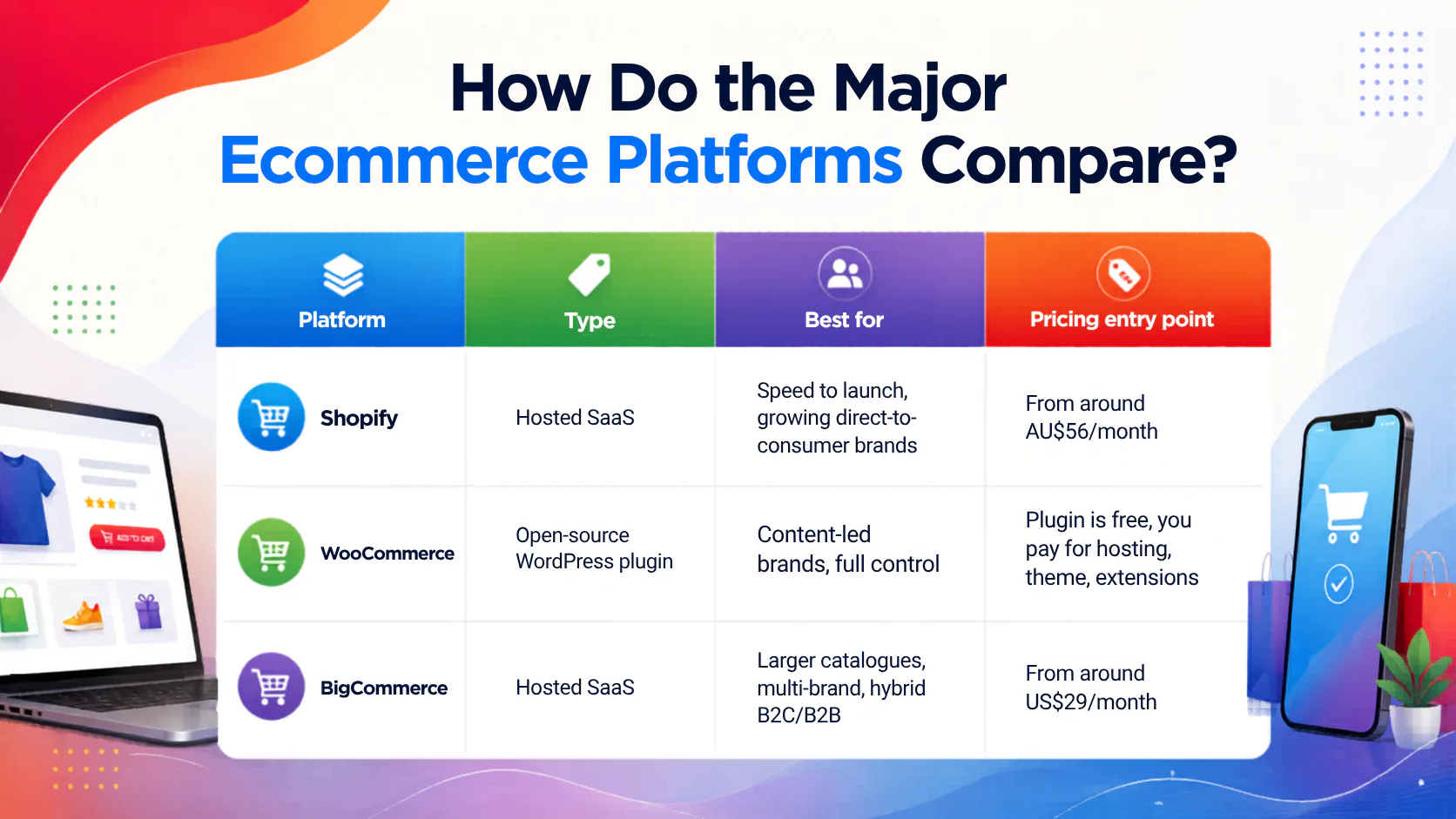
How Do the Major Ecommerce Platforms Compare?
Three platforms dominate the conversation for Australian B2C businesses in 2026. Shopify and WooCommerce are the two biggest ecommerce platforms in the world, and we’ve covered the head-to-head between them in more detail here. BigCommerce is the third we’d seriously consider, particularly for brands with large catalogues, complex product structures, or plans to add wholesale alongside their B2C store. There are others (Magento, Wix, Squarespace, Adobe Commerce), but for most B2C businesses, the choice comes down to these three.
Here’s how they sit at a glance.
| Platform | Type | Best for | Pricing entry point |
|---|---|---|---|
| Shopify | Hosted SaaS | Speed to launch, growing direct-to-consumer brands | From around AU$56/month |
| WooCommerce | Open-source WordPress plugin | Content-led brands, full control | Plugin is free, you pay for hosting, theme, extensions |
| BigCommerce | Hosted SaaS | Larger catalogues, multi-brand, hybrid B2C/B2B | From around US$29/month |
Shopify
Shopify is the default starting point for most new direct-to-consumer brands, and for good reason. It’s fast to launch, hard to break, and you don’t need a developer to get a basic store live. Shopify holds 26.2% ecommerce platform market share and leads with 28.8% of the top 1 million ecommerce websites. That dominance among the top end matters, because it’s where most of the apps, themes, agencies and case studies are pointed.
What Shopify does well:
- Genuinely fast to launch. A small business can have a credible store running in a week, sometimes less.
- Shopify Payments. The built-in payment processor avoids third-party transaction fees, though it’s not available in every country and currency combination.
- POS integration. If you sell in a physical store as well, Shopify POS keeps stock and orders in sync across channels.
- App ecosystem. Thousands of apps cover everything from reviews to subscriptions to loyalty programs.
- Sales channels. Sell directly from Instagram, Facebook, TikTok, Amazon and eBay through one admin.
What to watch:
- Transaction fees. If you use a payment gateway other than Shopify Payments, Shopify charges an additional fee on top of the gateway’s own processing rate.
- App stacking. Every app adds to your monthly bill and can slow your store down. Costs creep.
- Customisation limits. Shopify makes a lot of decisions for you. Forced URL patterns (/products/, /collections/) and a templated theme system are a feature for most stores, a constraint for some.
Pricing in Australia in 2026: Shopify Basic at around 56 AUD/month, Shopify Grow at around 149 AUD/month, and Shopify Advanced at around 575 AUD/month, with transaction fees ranging from 1.75% down to 1.4% plus 30¢ depending on plan. Shopify Plus sits above that for enterprise-level merchants.
WooCommerce
WooCommerce is a free, open-source plugin that adds ecommerce functionality to a WordPress site. If your business is already on WordPress, or if you want full control over your code, content and hosting, it’s a strong option. We’ve written more on what WooCommerce is and where it fits if you want the longer version.
WooCommerce leads globally with a 33.4% market share and powers over 6 million websites, making it one of the most widely used ecommerce platforms. Its strength is flexibility. You’re not locked into anyone’s theme system, payment processor or hosting environment.
What WooCommerce does well:
- Total customisation. It’s open source. You can change anything if you’re willing to put in the work or pay someone to.
- Content and SEO integration. Sits inside WordPress, which means your blog, landing pages and store live in the same system. Strong for brands with a content strategy.
- No platform transaction fees. You only pay your payment gateway’s processing fee.
- Huge extension library. Plugins for almost any functionality, free and paid.
What to watch:
- You manage the infrastructure. Hosting, security, backups, updates. Either you do this yourself or you pay someone to. Mettro handles this for clients on our support and maintenance plans.
- Performance takes work. A poorly built WooCommerce site is slow. A well-built one is fast. The difference is the build and the hosting, not the platform.
- More moving parts. WordPress core, theme, WooCommerce, payment gateway plugin, shipping plugin, SEO plugin. Each one needs to play nicely with the others.
If your business has strong content marketing, complex content needs alongside your store, or specific technical requirements that a SaaS platform won’t allow, WooCommerce earns its place. If you want to plug in and go, it’s probably not the right fit.
BigCommerce
BigCommerce is a hosted SaaS platform in the same category as Shopify, with a different emphasis. Where Shopify prioritises ease of use and a huge app ecosystem, BigCommerce prioritises native features and architectural flexibility. For B2C brands, that means fewer apps to bolt on, no platform transaction fees, and stronger handling of larger or more complex catalogues. Its presence in Australia is smaller than Shopify’s, but the platform is mature and well-suited to mid-sized B2C businesses that have outgrown a simple template store.
What BigCommerce does well:
- 0% platform transaction fees on every plan. You only pay your payment gateway’s fee. Over time, that can save mid-volume B2C stores thousands a year.
- Stronger native features. Faceted search, advanced filtering, abandoned cart recovery, customer segmentation. Things you’d often need apps for on Shopify.
- Better suited to large catalogues. Higher native product variant limits and stronger category management make it a fit for brands with deep product ranges.
- Multi-storefront. Run multiple regional or sub-brand B2C sites with shared inventory, on standard plans rather than enterprise.
- More flexible URL structure. Useful if SEO migration from another platform is a concern.
- B2B-ready when you need it. If you’re a B2C brand that wants to add wholesale or trade pricing later, the tools are native rather than bolted on.
What to watch:
- Smaller app ecosystem. Around 1,000 apps versus Shopify’s 6,000+. Mainstream needs are covered, niche ones might need custom development.
- Revenue caps trigger plan upgrades. Cross certain annual sales thresholds and you’re pushed to the next tier or to Enterprise.
- Less Australian presence. Fewer local agencies, fewer local case studies, less of a community than Shopify here.
- Steeper learning curve than Shopify. More configurability means more decisions during setup.
What About Headless and Composable Commerce?
For larger brands and businesses with complex requirements, headless commerce is worth knowing about. It works by separating the front end (what the customer sees) from the back end (the commerce engine), connecting them through APIs.
Both Shopify (through Hydrogen) and BigCommerce (through Catalyst) support headless builds. The advantage is performance, design freedom and the ability to deliver the same content across multiple channels. The trade-off is complexity and cost. For most B2C brands turning over under a few million a year, it’s not the right call. For brands with the scale to justify it, the performance gains can be material.
How Do You Choose the Right Ecommerce Platform?
There’s no universal best platform. There’s the platform that fits your business, your team, your catalogue and your budget. A few honest questions will get you most of the way there.
- How much technical capability do you have in-house, or how much are you willing to outsource? Shopify needs the least. WooCommerce needs the most.
- Is your business already on WordPress, and is content a big part of how you sell? That tilts toward WooCommerce.
- Are you selling direct-to-consumer with a fairly simple catalogue, and you want to launch fast? That tilts toward Shopify.
- Do you have a large or complex catalogue, multiple sub-brands, or plans to add wholesale alongside your B2C store? That tilts toward BigCommerce.
- Are you planning to scale internationally? Shopify’s Markets feature is the strongest out of the box. BigCommerce’s multi-storefront is the strongest if you need separate sites per region. WooCommerce can do either with the right setup.
Where to Next
The platform you pick matters, but the build, the content, the marketing and the ongoing care matter more. We’ve built ecommerce stores on Shopify, WooCommerce and custom platforms for clients.
For a closer look at how we approach a full website design and development project, the process is the same whether the end product is ecommerce or not. If you’re thinking about a new store or replatforming an existing one, the most useful next step is a conversation about what you’re trying to achieve and which approach fits.
Talk to us about your ecommerce site.