The honest answer is no, not every business does. Plenty of businesses are doing fine with someone capable in-house, a few sharp freelancers, and a clear sense of what they’re trying to achieve. The real question isn’t whether you need a digital marketing agency. It’s whether your current setup is actually delivering on a digital marketing strategy, or just keeping the lights on.
That distinction matters. If your marketing is reactive, scattered across tools no one fully owns, or driven by whoever is loudest in the room, an agency might help. If you’ve got someone good, briefed well, with a budget and a plan, you might not need one at all.
This post walks through the honest version of that decision. What an agency actually does, when in-house works better, where a hybrid makes sense, and the questions to ask yourself before you commit either way.
What Does a Digital Marketing Agency Actually Do?
A digital marketing agency is a team that plans and runs marketing across digital channels on your behalf. That usually covers SEO, paid advertising, content, email, social media, analytics, and the strategy that ties all of it together.
The work splits into two layers. The first is execution. That’s the visible stuff. Ads running, content going out, reports landing in your inbox. The second is strategy, which is harder to see but matters more. It’s the bit that decides which channels are worth the spend, what the message should be, and how to measure whether any of it is working.
A good agency does both. A weak one only does the first. The strategy layer is where most of the value sits, which is why we treat digital strategy as the starting point rather than a deliverable bolted on at the end.
When a Digital Marketing Agency Is Worth the Money
There’s a point most businesses hit where the marketing gets bigger than the person running it. Not because they’re not good. Usually they are. But the job has grown into five jobs in a trench coat. SEO, ads, email, content, the website, and the reporting. One person can hold maybe two of those well.
That’s the most common moment to bring in an agency. A few others worth naming.
- You’re spending serious money on paid ads with no clear sense of what’s working
- Your website is generating traffic but not leads, and no one can tell you why
- You’ve got a strategy in your head, but nothing written down that anyone else can run with
- You’re moving into a new market, channel, or product line and need senior thinking quickly
- You’ve tried freelancers and ended up project-managing five different people
The common thread is value for the spend. An agency is worth it when the cost of getting it right is significantly higher than the agency fee, and the cost of getting it wrong is higher still. That’s especially true once your work spans multiple channels. Cross-channel digital marketing only works when the channels talk to each other, and that coordination is hard to do part-time.
When You Don’t Need One
We say this as an agency. Sometimes the answer is not to hire one.
If most of your marketing comes from word-of-mouth and referrals, hiring an agency likely won’t make a big difference. If your business is small enough for one person to handle everything effectively, let them keep doing their thing. For specific, contained needs like a single campaign, a one-off landing page, or a quick fix, a freelancer or contractor will probably be cheaper and quicker.
The other reason not to hire one is honesty about your own setup. Agencies need a brief, a budget, a decision-maker, and someone on your side who can answer questions and approve work. If you can’t give them that, you’ll get bad results no matter how good the agency is. Fix the inputs first.
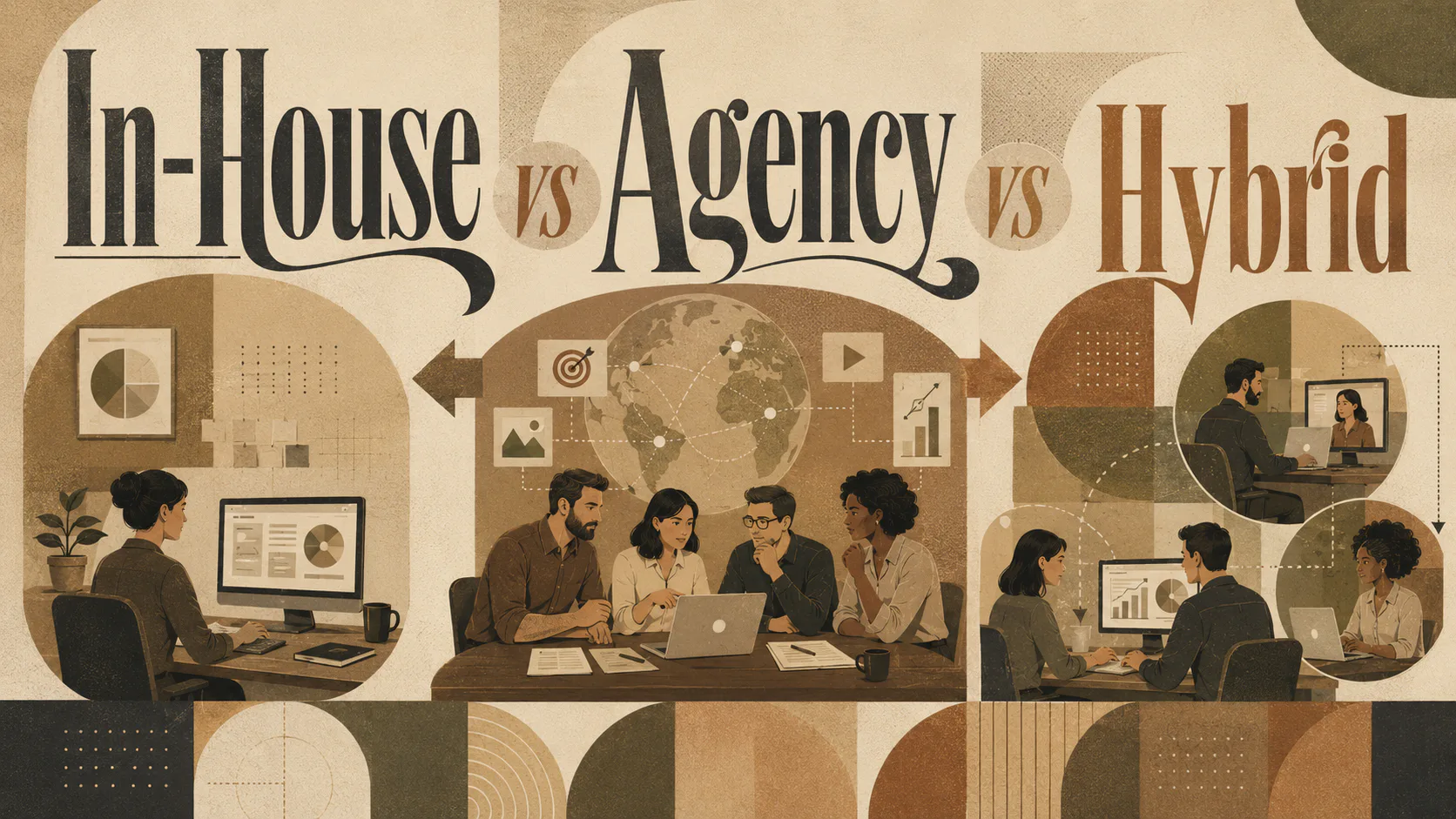
In-House vs Agency vs Hybrid
There’s no universally right answer. Each model has trade-offs.
| Model | Strengths | Weaknesses | Best for |
|---|---|---|---|
| In-house | Deep product knowledge, always available, lower long-term cost at scale | Hard to hire senior generalists, single point of failure, narrow skill set | Businesses with steady, predictable marketing needs and clear strategy |
| Agency | Senior thinking, broad skill set, plug-and-play, accountable to outcomes | Less embedded, costs more per hour, only as good as the brief | Businesses needing strategy, multi-channel work, or capacity that scales up and down |
| Hybrid | In-house owns the brand and day-to-day, the agency handles strategy or specialist channels | Needs clear lines of who does what, more coordination | Most mid-size businesses |
The hybrid model is a common landing point. An in-house person who knows the business cold owns brand and day-to-day work, and an agency comes in for the bits that need senior strategic thinking, specialist execution, or capacity the internal team doesn’t have.
How to Tell Which One You Need
Three questions usually settle it.
First, what kind of help do you actually need? If you have a clear strategy and just need execution, the brief looks different to a business that needs the strategy built first. Both are legitimate reasons to hire an agency. They just point to different kinds of engagement and different kinds of agency. Knowing which one you’re in changes who you should be talking to.
Second, who is going to own the work? An agency without a clear client-side owner is a slow-motion disaster. Someone has to be accountable for briefing, reviewing, deciding, and protecting the agency from internal noise. If that person doesn’t exist, fix that before you sign anything.
Third, what’s the cost of staying where you are? Marketing spend that isn’t working is the most expensive kind. If you’re spending on ads, content, or tools and you can’t tell anyone what return you’re getting, the cost of doing nothing is already high. An agency might be cheaper than the status quo.
What to Look For if You Do Hire One
If you’ve decided an agency makes sense, the criteria that matter aren’t the ones agencies usually lead with.
Senior people doing the work matter more than the size of the team. A pitch full of strategists you’ll never speak to again is a red flag. Ask who you’ll actually work with day to day, and meet them before you sign.
Industry experience helps but isn’t essential. What matters more is whether they understand business, not just marketing. The right questions early on are about your customers, your margins, and what you’re actually trying to do. If the conversation is all channels and tactics before any of that’s been understood, that tells you something.
A clear point of view is good. Agencies that agree with everything you say will agree with the next agency too. You want people who’ll push back when it matters.
The Real Question
Whether you need a digital marketing agency depends on whether your current setup is producing a real strategy or just running tactics. If you’ve got the strategy, the people, and the discipline to execute, you might not need one. If any of those are missing, an agency can fill the gap, but only if you’re set up to brief them well and decide quickly.
The worst outcome isn’t hiring the wrong agency. It’s spending another year not really sure if your marketing is working.
If you’d like an honest read on which one you are, we’re happy to have that conversation.
Talk to us about your strategy