Search has changed more in the last two years than it did in the previous decade, and SEO, AEO and GEO are now three separate disciplines because of it. People used to type a few keywords and click a blue link. Now they ask a full question and read the answer the search engine writes for them. Often, no one clicks anything.
If your business still treats search as a ranking exercise, you’re optimising for a behaviour your customers have already moved past. The companies showing up in ChatGPT answers, Google AI Overviews and voice results right now are the ones doing the other two as well.
Here’s what each one means, where they overlap, and what to prioritise.
What Is SEO?
Search Engine Optimisation (SEO) is the practice of making your website visible in traditional search results. It works by signalling to search engines what your content is about, how trustworthy your site is, and how well it serves the person searching. Done properly, SEO covers a wide field, but the work tends to fall into a few areas.
- Matching content to search intent, whether someone wants information, a local supplier, or a transaction
- Using keywords, headings and structure that reflect how people actually search
- Producing content that genuinely answers the question
- Linking internally so readers can find related pages
- Earning backlinks from credible external sites
- Building offline credibility through PR, directories and partnerships
- Keeping pages fast and mobile-friendly
- Maintaining clean URLs, sitemaps and proper indexing
- Securing the site with HTTPS
SEO still matters. It’s the foundation everything else sits on. But it’s no longer the whole picture.
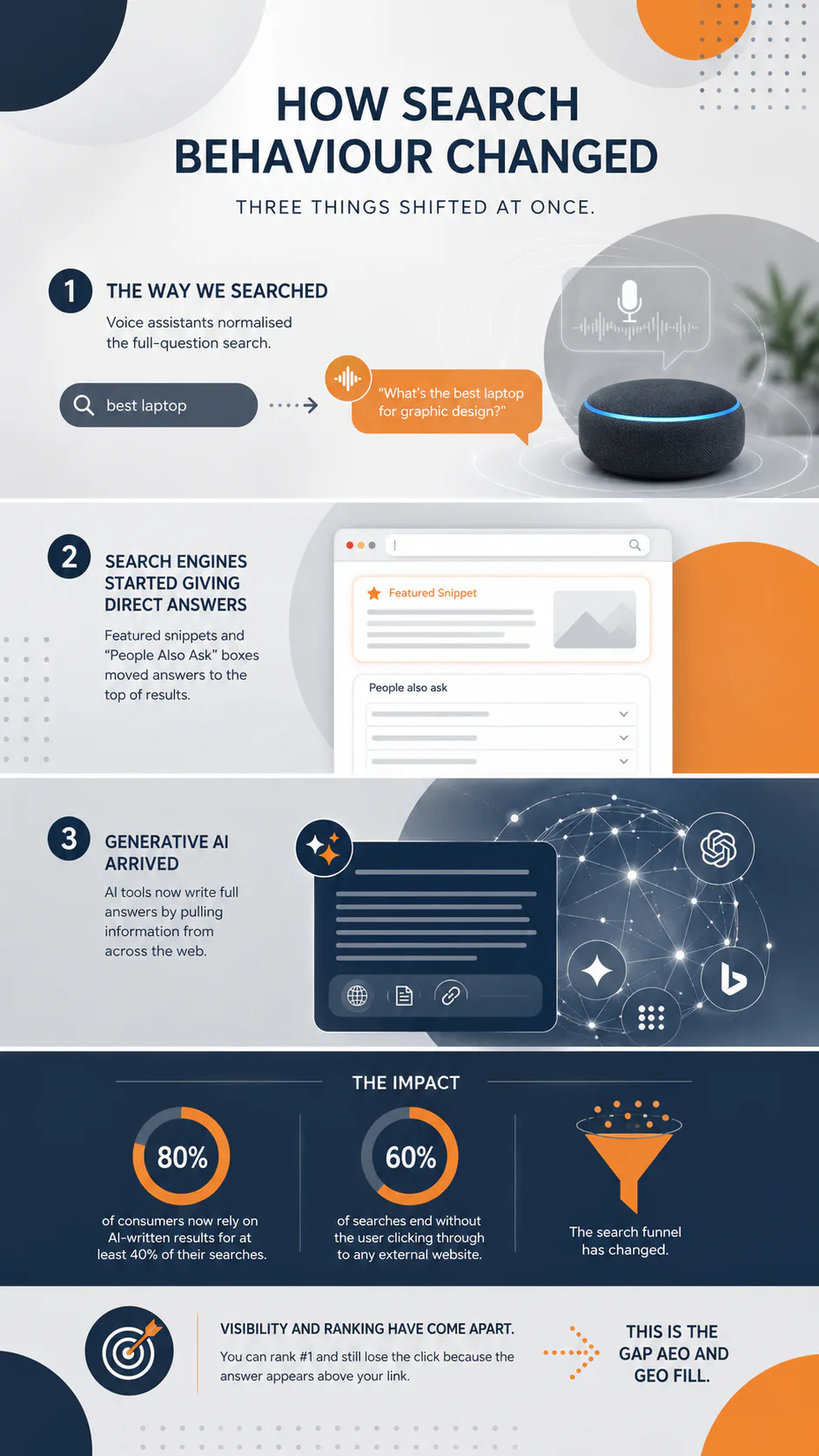
How Search Behaviour Changed
Three things shifted at once.
Voice assistants normalised the full-question search. Instead of typing “best laptop”, people started asking Siri or Alexa “What’s the best laptop for graphic design?” Search engines responded by showing direct answers at the top of results, in featured snippets and “People Also Ask” boxes.
Then generative AI arrived. ChatGPT, Google AI Overviews, Perplexity and Bing Chat now write full answers by pulling information from across the web. Many users get what they need without clicking through to a single website. These are zero-click searches, and they’re a growing share of all search activity.
According to research from Bain & Company (2025), about 80% of consumers now rely on AI-written results for at least 40% of their searches, and around 60% of searches end without the user clicking through to any external website. That is not a marginal change. It is the search funnel turning into a different shape, and it has happened over roughly 24 months.
The result is that visibility and ranking have come apart. Your site can rank number one and still lose the click, because the search engine writes the answer above your link.
This is the gap AEO and GEO fill.
What Is AEO?
Answer Engine Optimisation (AEO) is the practice of structuring content so it appears as a direct answer. It works by writing in formats that search engines can extract cleanly, such as concise responses under question-led headings, FAQ blocks, and lists.
AEO is what gets you into featured snippets, “People Also Ask” boxes, and voice assistant responses. A competitor can rank above you in the standard listings and still lose the click, because your content is the one being read aloud or pulled into the snippet box.
Practical AEO moves
- Phrase headings as questions your customers actually ask
- Answer the question in the first one or two sentences below the heading
- Add a real FAQ section, not a thin one
- Use schema markup to help search engines identify answers, products, and reviews.
AEO rewards directness. If your content opens with a wind-up paragraph before getting to the point, it won’t be picked.
What Is GEO?
Generative Engine Optimisation (GEO) is the practice of making your content eligible to be cited inside AI-generated answers. It works by combining clarity, credibility and context, so generative models trust your content enough to include it when they synthesise a response.
GEO became necessary because the rules changed. AI tools don’t just index pages. They read across many sources and write a single answer, often without a click-through. Three things follow from that.
You have less control over how your content is presented. Visibility no longer depends only on keywords. The content most likely to be cited is the content that’s clearly written, well-structured, and obviously credible.
Why GEO Matters Right Now
According to Pew Research Center (2025), Google searches that triggered an AI Overview saw users click on a traditional search result only 8% of the time, compared with 15% on searches without one. The traffic loss is real, and it’s already happening.
If your content is well-structured, easy to parse, and backed by named sources, it can be included in AI-generated responses regardless of where it ranks in the standard results. Most competitors haven’t optimised for this yet, which is exactly why the opportunity is there. The link to content marketing is direct. The format and depth of your content now decide whether AI quotes you or quotes someone else.
Practical GEO moves
- Write conversationally, the way people actually phrase questions
- Use clear headings and a logical structure
- Cover the subtopics your customers care about, with examples
- Cite named sources, statistics and expert quotes
- Use short paragraphs, tables and summaries that AI can lift cleanly
Why Does the AI Search Shift Matter for Your Business?
Because the people you want as customers are already searching this way.
A buyer researching enterprise software no longer starts on Google’s first page. They ask ChatGPT to compare three vendors. The vendor that gets named in the answer is the one that gets the meeting. The two that don’t, don’t.
The shift is already underway. Sites that were getting strong organic traffic 18 months ago are watching it slide, not because their SEO has weakened, but because the search engines are answering the question themselves. Without AEO and GEO work, your content is feeding the answer without getting credit for it.
The good news. Most businesses haven’t moved yet. The window to be the cited source, the featured answer, and the brand the AI mentions by name is still open.
SEO, AEO and GEO at a Glance
| Focus area | SEO | AEO | GEO |
|---|---|---|---|
| Main purpose | Rank in search results | Appear as instant answers | Be cited in AI-generated responses |
| Content style | In-depth, keyword-driven | Question-led, concise, structured | Context-rich, credible, conversational |
| Where it shows | Organic listings, local packs | Featured snippets, People Also Ask, voice | AI Overviews, ChatGPT, Perplexity |
| Primary signal | Authority and relevance | Clear, extractable answers | Clarity, credibility, citation-readiness |
| What it rewards | Depth and link equity | Directness | Trustworthy structure |
The three overlap more than they compete. Strong SEO content is usually a good starting point for AEO and GEO. The work is in the additional layer of structure, sourcing and clarity that gets your content used as well as ranked.
A Starter Checklist
Use this as a working list, not a tick-box exercise. Each item earns its place because it serves all three disciplines, not just one.
Foundations
- Audit your top pages for speed, mobile experience and broken links
- Confirm HTTPS across the site
- Claim and fully complete your Google Business Profile
- Check Name, Address and Phone consistency across directories
Content and intent
- Assign one core topic per page
- Identify the real questions customers ask around that topic
- Phrase headings as those questions
- Answer in the first sentence or two
- Add genuine FAQ sections that address what people actually want to know
Authority and credibility
- Cite named, dated sources, not “studies show”
- Include author bios, reviews, credentials and trust signals
- Pursue backlinks from suppliers, associations and industry publications
- List on relevant directories, including niche ones
- Implement schema markup for FAQ, HowTo, Product, Service and LocalBusiness
- Validate your structured data with a schema testing tool
Format
- Keep paragraphs short
- Use tables, bullet points and summaries where they aid extraction
- Add step-by-step sections for how-to content
- Build comparison pages with clear pros, cons and verdicts
How to Measure Whether It’s Working
Tracking matters more than ever because some of the most valuable visibility now happens off your site.
Search performance
- Organic traffic from Google Analytics
- Keyword rankings tracked through Ahrefs, Semrush or similar
- Click-through rate from search impressions
- Bounce rate and time on page as engagement signals
- Conversions attributable to organic traffic
AI visibility
- Manual checks. Ask ChatGPT, Perplexity, and Google AI Overviews questions a customer would ask. Are you cited?
- Brand mentions in AI responses, tracked over time
- Referral traffic from AI tools, where attribution is available
Business impact
- Lead volume and quality
- Revenue from organic traffic
- Local actions like calls, direction requests and reviews
- Customer retention and referral rates
If you’re only watching rankings, you’re missing half of the picture that’s now driving outcomes.
What This Looks Like in Practice for Larger Sites
For a five-page brochure site, picking up SEO, AEO and GEO is a quick exercise. For a mid-size or enterprise site with hundreds or thousands of pages, the work is different. The volume changes how you prioritise, where the biggest wins are, and which problems show up first.
A few things tend to come out in the wash.
Most pages don’t need optimising for all three. A long-tail product page might only need solid SEO. Definitional pages (what is X, how does Y work) are where AEO and GEO pay off. Buyer-comparison pages are where GEO matters most, because that’s where AI tools cite from. Sort by intent before you sort by traffic.
Schema is non-negotiable at scale. Manually adding the FAQ schema to ten pages is fine. Across a thousand pages, it has to be templated through the CMS. If your platform doesn’t support that cleanly, that’s the first technical problem to solve.
Internal linking does more work than people think. AI tools and search engines both use internal links to understand topical relationships. A well-linked page on a credible domain is more likely to be cited than a strong but isolated page elsewhere.
Content audits get harder, not easier. Old blog posts that used to rank but now sit unread are often the biggest GEO liabilities. They’re feeding outdated information into AI answers about your brand. Pruning, consolidating or rewriting them is usually a higher-impact move than producing new content.
Reporting needs to expand. If your monthly report still leads with keyword rankings, it’s measuring the last decade’s metric. Add AI citation checks, even manual ones, and report on them as a tracked line item.
The pattern across all of this is the same. Stop treating search as a single discipline with one set of tactics. Treat it as three related but distinct ones, each rewarded for different things.
Common Misconceptions About AEO and GEO
A few misreadings come up often in client conversations. Worth flagging them.
“It’s just SEO with extra steps.” It isn’t. SEO optimises for ranking in a list. AEO optimises for being extracted as the answer. GEO optimises for being cited as a source inside an AI-written response. The mechanics overlap, but the goals are different, and the formats that win each one differ, too. A page can rank well and still never be quoted by ChatGPT.
“We’ll wait until the dust settles.” Waiting is itself a choice, and a costly one. AI tools build their citation patterns on the content they encounter now. Brands being cited today are being cited tomorrow. The structural advantage of getting in early compounds the way early backlinks did fifteen years ago. Sitting it out means catching up to competitors who are already there.
“AEO and GEO mean writing for robots, not people.” The opposite is closer to true. Both reward content is written the way a knowledgeable person would actually explain something to a customer. Clear questions, direct answers, named sources, sensible structure. If your content reads like a press release or a brochure, it won’t be picked, and human readers will bounce off it for the same reasons.
“We can’t measure it, so we can’t justify it.” Direct measurement is harder, but it isn’t impossible. Manual citation checks across ChatGPT, Perplexity, Gemini and Google AI Overviews give you a baseline. Track it monthly, watch which competitors get named, and report it as a tracked metric. It will be imperfect, and it will still be more honest than pretending the shift isn’t happening.
“This only matters for B2C.” Bain’s research found click-through rates falling as much as 30% in some B2B categories, including B2B software. B2B buyers research with the same AI tools as everyone else, and they often arrive at the vendor shortlist before the first sales conversation. If you sell complex services, the early-stage research is exactly where AEO and GEO matter most.
Where to Start
Pick your three highest-traffic pages. Read each one and ask honestly. Does it answer the main question in the first two sentences? Does it have an FAQ section? Are claims sourced and dated? Could ChatGPT lift a useful answer from it without rewriting? Does the page tell a credible source what your business actually does, or is it generic enough to apply to any competitor?
If the answer is no on more than one of those, you have your starting point. From there, it’s worth zooming out and treating it as a digital strategy question, not a content one. The changes that pay off tend to cut across content, structure and technical setup.
Search has changed. The brands being seen are the ones that have adapted. If you’d like a hand working out where to start, get in touch with our team. We can take a look at your current site, identify where you’re losing visibility, and map out a practical plan that covers all three.