If you’ve been told your business “needs content marketing” but you’re not entirely sure what that means in practice or whether it’s worth your time, you’re not alone. Content marketing is one of those terms that gets thrown around a lot without much clarity about what it actually involves or what it can realistically deliver.
Content marketing is the practice of creating useful, relevant material (articles, guides, videos, case studies and more) that helps your target audience solve problems, make decisions, or understand something better. It’s not advertising. You’re not pushing a sales message. You’re building trust by being genuinely helpful, and that trust turns into business over time.
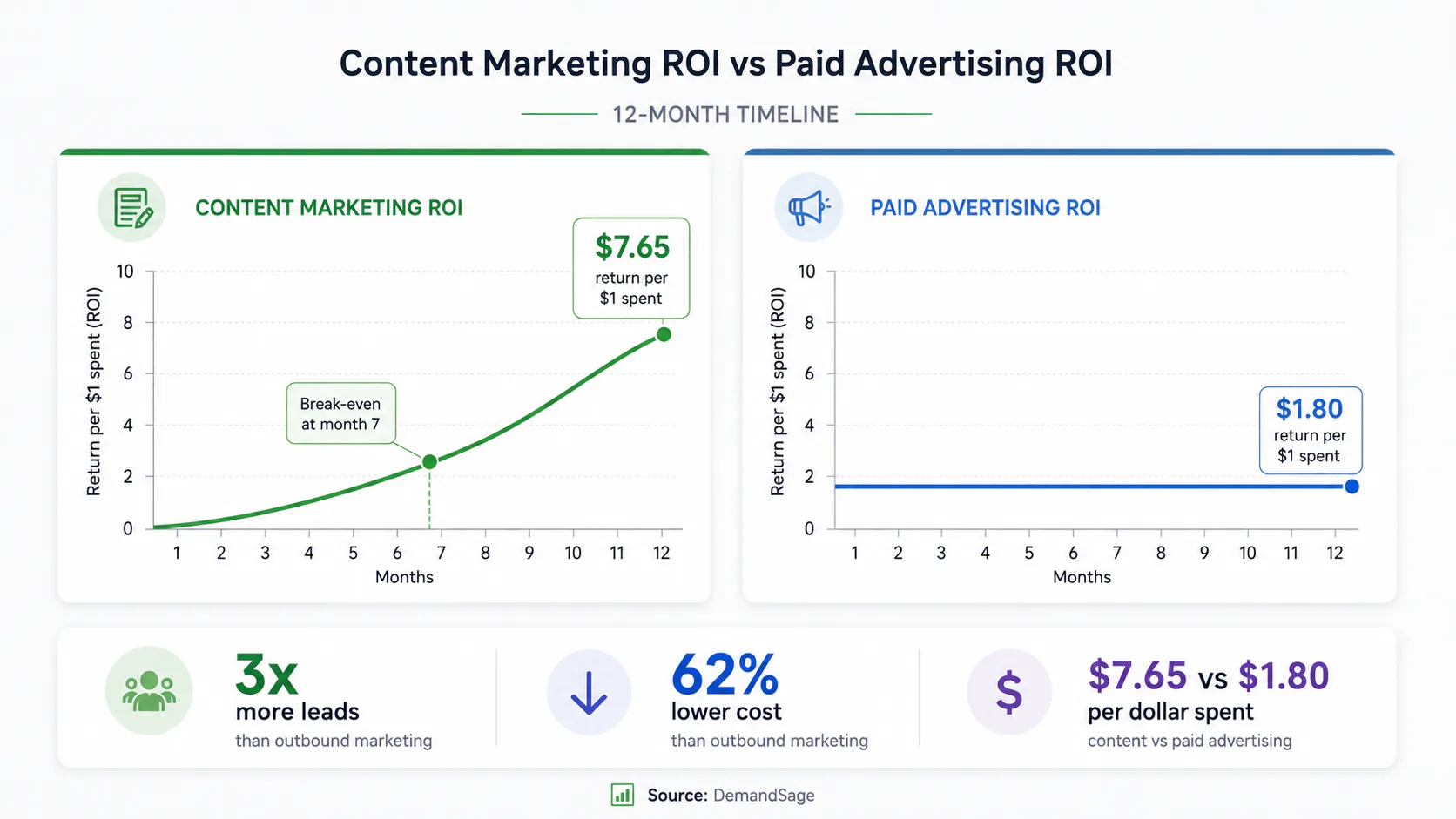
The numbers back this up. Industry data shows that content marketing returns an average of $7.65 for every $1 spent, compared to roughly $1.80 for paid advertising. And unlike paid ads, where traffic disappears the moment you stop paying, the returns from content compound over time as your library of articles continues to attract visitors.
Content marketing for business is one of the most cost-effective ways to build visibility. It attracts the right customers and creates long-term value from your website. Here’s how.
It builds brand visibility without ongoing ad spend
Every piece of content you publish is a new entry point to your business. A well-written blog post that answers a question your customers are asking can rank in Google, get shared on social media, and continue bringing people to your website for months or years after you publish it.
That’s fundamentally different from paid advertising, where traffic stops the moment you stop paying. Content marketing requires an upfront investment of time and effort, but the returns compound. A library of 30 or 40 genuinely useful articles creates a consistent stream of organic traffic that you don’t have to keep paying for.
The data illustrates this clearly. Research from DemandSage shows that content marketing generates over three times as many leads as outbound marketing while costing 62% less. And those economics improve the longer you publish. Content gets cheaper per lead over time as older posts continue ranking, while ad costs trend upwards as competition increases.
For businesses with limited marketing budgets, that compounding effect matters. You’re building an asset, not renting attention.
It improves your search engine rankings
Search engines reward websites that consistently publish high-quality, relevant content. Every article you write is an opportunity to rank for keywords your potential customers are searching for.
But it’s not just about volume. Google’s algorithms increasingly prioritise content that demonstrates genuine expertise and provides real value to the reader. A single in-depth guide that thoroughly covers a topic will outperform ten thin, shallow posts on the same subject. This is why the “publish three 500-word blogs a week” approach that many businesses were sold on years ago no longer works.
What does work is understanding what your customers are actually searching for. Then, creating content that answers those questions more completely and more clearly than anyone else. That’s how you compete with larger companies in organic search. Not by producing more content, but by producing better content on the specific topics where you have genuine expertise.
How this works in practice: We saw this first-hand with Carpet One, a national flooring retailer. Rather than guessing what content to create, we started with the data. Using a combination of SEMrush, Google Analytics, Search Console, and Google Trends, we built a clear picture of exactly what customers were searching for when it came to flooring. We then used our keyword research tool, Hit List, to refine the specific phrases and sentence structures people were using, so the content would match the way real customers actually ask questions.
From there, we created brief outlines for each topic and used AI to draft initial structures. But here’s the part that made the difference: we sent those drafts out to Carpet One store owners. These are people who’ve been laying and selling floors for years. They reviewed the content, added their own expertise, and made sure every answer was accurate and grounded in real experience. The result was content that had the structure and keyword targeting to rank well, combined with the authenticity that only comes from genuine industry knowledge.
The impact on organic traffic to the Carpet One website was significant. It’s a clear example of what happens when you combine smart research, efficient production, and real human expertise in the right order.
It feeds AI search tools, not just Google
This is the piece most businesses aren’t thinking about yet, but should be. AI-powered tools like ChatGPT, Perplexity, Google’s AI Overviews, and others are increasingly how people find answers. When someone asks an AI tool “what’s the best way to market my plumbing business,” the AI pulls its answer from web content. And it tends to favour content that is clearly structured, factually specific, and written with genuine authority.
Content marketing written for humans first (clear, well-organised, substantive) is exactly what these AI tools look for when compiling answers. Businesses that are publishing quality content now are positioning themselves to be cited and referenced by AI tools as these become a bigger part of how people search.
The takeaway: write content that directly answers the questions your audience asks, structure it clearly, include specific details and examples, and make sure your expertise comes through. That’s good for Google, good for AI tools, and good for the humans reading it.
It supports customers at every stage of the buying journey
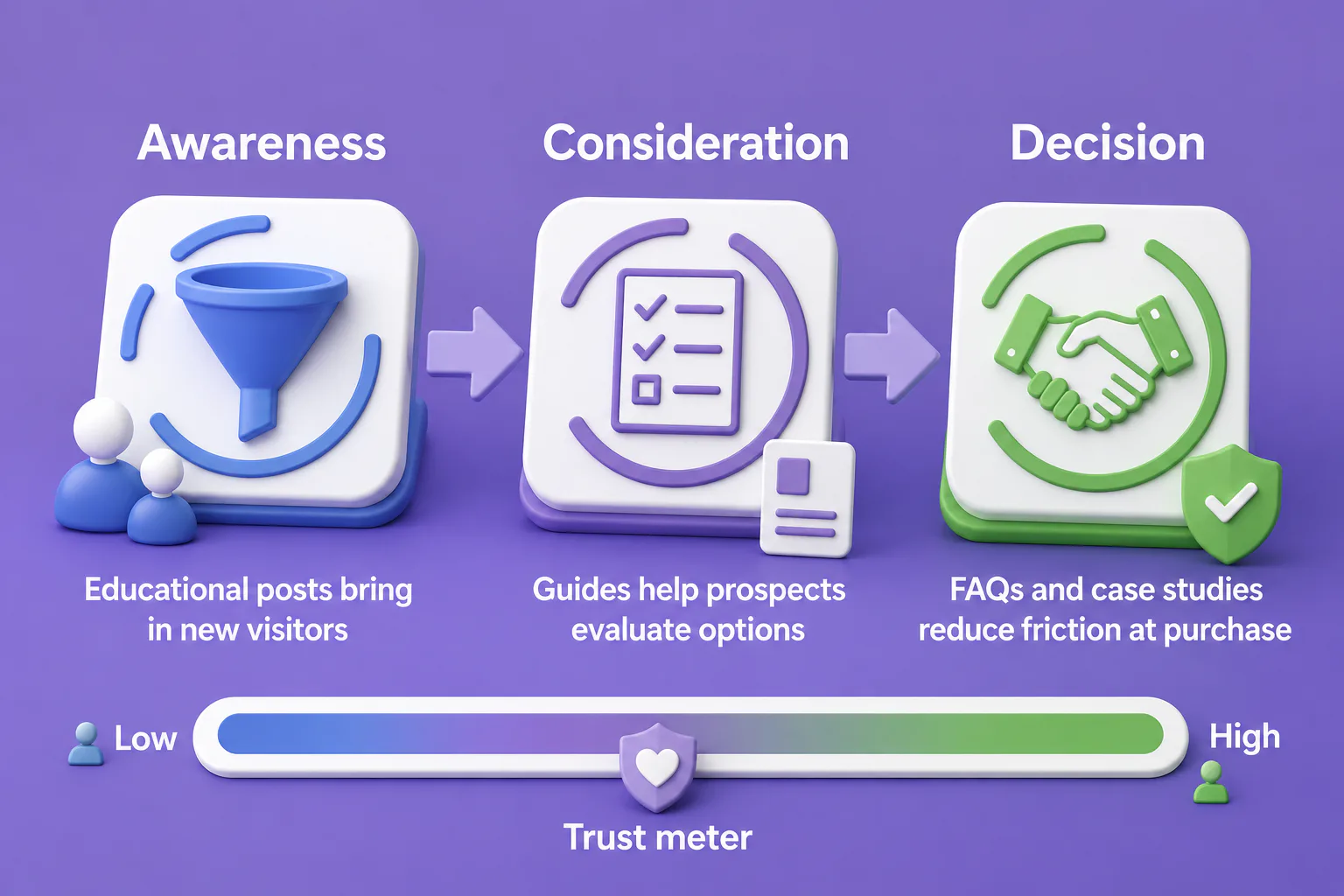
Not everyone who visits your website is ready to buy. Some are just realising they have a problem. Others are comparing options. Some are almost ready to commit but need one last piece of reassurance.
Content marketing lets you meet people wherever they are in that process:
- Awareness stage: Educational articles that help people understand a problem or opportunity. A landscaping company might publish a guide on “how to tell if your retaining wall needs replacing” that reaches homeowners who haven’t started looking for a landscaper yet.
- Consideration stage: Comparison guides, case studies, and more detailed content that helps people evaluate their options. This is where you demonstrate your expertise and show how you approach the work.
- Decision stage: Detailed service pages, FAQs, testimonials, and content that addresses last-minute concerns. This is the content that converts someone from “interested” to “ready to get in touch.”
Research from the Content Marketing Institute shows that 87% of B2B marketers say content successfully created brand awareness over the past 12 months. But awareness is just the entry point. The real value is the trust that accumulates across multiple touchpoints. One article is a data point. Ten articles is a relationship.
Most businesses only create content for the decision stage (service pages and sales copy). The businesses that also invest in awareness and consideration content build a much larger audience and earn trust long before the sales conversation starts.
It builds trust and positions you as an authority
People buy from businesses they trust. And trust, especially for services where the stakes are high, doesn’t come from a slick homepage or a strong logo. It comes from demonstrating, consistently, that you know what you’re doing.
When a potential customer reads three or four articles on your site that are well-written, genuinely helpful, and clearly written by someone who understands the topic deeply, they form an impression. That impression is: these people know their stuff. When they’re ready to buy, you’re already the frontrunner.
This is particularly powerful when you’re competing against larger firms. A big company might have brand recognition, but a business that’s publishing thoughtful, expert content can out-position them on trust. The content becomes proof of your expertise in a way that a logo and a tagline can’t replicate.
It generates leads without a hard sell
One of the most effective uses of content marketing is lead generation. But not in the aggressive, pop-up-on-every-page way that annoys people.
Create something genuinely valuable (a detailed guide, a checklist, a template, a calculator). Then offer it in exchange for an email address. This only works if what you’re offering is good enough that someone would actually want it. A flimsy two-page PDF doesn’t cut it. A comprehensive, well-designed guide that saves someone hours of research does.
The cost-per-lead numbers make the case clearly. According to First Page Sage’s benchmarks, organic content for B2B SaaS generates leads at around $164 per lead on average. And the content figure drops over time as posts accumulate search traffic, while ad costs tend to go the other way.
Once you have someone’s email address, you can nurture that relationship over time with useful follow-up content. Not a sales pitch every week, but genuinely helpful information that keeps your business front of mind until they’re ready to take the next step.
Content also makes paid ads work harder. When someone clicks an ad and lands on a site with a library of useful articles, they’re more likely to trust the brand and convert. Blending paid and organic strategies tends to reduce overall cost per lead compared to relying on either channel alone.
Some examples of lead magnets that work well:
- A template or checklist relevant to your industry (e.g., “Website launch checklist for business owners”)
- A detailed guide that goes deeper than your blog content (e.g., “The complete guide to hiring a builder in Queensland”)
- A calculator or tool that helps people make a decision (e.g., a renovation budget estimator)
- A curated resource pack that saves research time
It reduces the load on your sales and support teams
This is one of the most underrated benefits of content marketing. And it’s the one that business owners tend to appreciate most once they see it in action.
Think about the questions your team answers repeatedly. Every business has them. “How much does this cost?” “What’s the process?” “How long does it take?” “What’s the difference between option A and option B?” Every time a team member answers one of these by email or phone, that’s time they can’t spend on higher-value work.
Now imagine those questions are thoroughly answered on your website. A well-written FAQ page, a clear process explainer, and a detailed pricing guide. Customers find their own answers, come to you better informed, and your team spends less time on repetitive queries and more time on the conversations that actually close deals.
This also shortens the sales cycle. When a prospect has already read your case studies, understands your process, and knows your pricing ballpark before they pick up the phone, that first conversation starts much further along than it would with someone who knows nothing about you. A blog post costs money to produce once and then serves every future visitor at zero marginal cost. A support interaction costs money every single time.
It gives you content to use everywhere else
Every piece of content you create can be repurposed across multiple channels, which multiplies its value significantly.
A single well-researched blog post can become a LinkedIn article or a series of social media posts. Key points from a guide can feed your email newsletter. A case study can be referenced in a sales proposal. Statistics or insights from your content can be pulled into presentations.
This is especially valuable for lean teams that can’t produce original content for every channel separately. Instead of creating from scratch for your blog, your socials, your emails, and your sales materials, you create one strong piece and adapt it. The core thinking is done once, and the distribution extends its reach.
The key is to start with quality. A mediocre blog post doesn’t become better content when you chop it up and post it elsewhere. But a genuinely useful article becomes a rich source of material that can be reshaped and reused for months.
Choosing the Right Content Formats
Not every business needs every type of content. The formats that work best for you depend on your audience, your industry, and your capacity to produce them well. Here’s a practical overview of the main options:
Blog articles are the foundation for most content marketing strategies. They’re the most accessible format to produce, support SEO directly, and give you material to share across other channels. For most businesses, this is where to start.
Case studies are powerful for service businesses and B2B companies where prospects need proof that you can deliver. A good case study tells the story of a real client engagement. What the challenge was, what you did, and what the measurable outcome was. They’re one of the most persuasive content formats because they’re grounded in real results.
Video content has the advantage of building a personal connection quickly. Even short, simple videos (a 2-minute explainer, a walkthrough, a customer testimonial) can make your business feel more human and approachable. You don’t need professional production. A well-lit, clearly spoken video recorded on a phone is better than no video at all.
Downloadable guides and resources (ebooks, whitepapers, templates, checklists) serve double duty. They provide deeper value than a blog post, and they work as lead magnets when gated behind an email signup. These take more effort to produce but tend to have a longer shelf life.
FAQ and help content are often overlooked but incredibly practical. It reduces support load, improves the user experience on your website, and performs well in both traditional search and AI-powered search tools because of its clear question-and-answer structure.
Don’t try to do everything at once. Start with the format that’s most realistic for your team to produce consistently, do it well, and expand from there.
Mettro is a digital agency that helps businesses get more from their marketing. If you’d like help developing a content strategy, get in touch.