Customer language is the gap between what people actually say and what brands write about them. Your customers don’t talk the way your website does. They use shorter words. Their description of a problem sounds nothing like the way your team would write it. Your homepage takes a paragraph to get there. Closing that gap is one of the most useful things a comms lead can do, and it doesn’t take a research budget. It takes attention.
What Is Customer Language?
Customer language is the specific words, phrases and patterns your customers use when they talk about their problems, their goals, and the things they buy. It works by capturing the way they describe their world, not the way your industry describes it.
Two examples make the point. A pest control company writes “integrated pest management solutions” on its website. Its customers ring up and say “there’s something in the roof.” A software product calls itself “enterprise workflow orchestration.” Its users tell colleagues it “stops emails getting lost.”
The two languages describe the same product. Only one gets used by the people writing the cheque.
Why Does Customer Language Matter?
Customer language matters because it does two jobs at once. It makes your copy easier to understand, and it makes your brand feel like it gets the reader. When someone arrives on a page that describes their situation in their own words, two things happen quickly. They believe you understand the problem. They stay long enough to read what you do about it.
Brands that miss this sound generic. Their copy could be lifted onto any competitor’s site, and nobody would notice. The penalty is real. That’s the cost of writing in industry language instead of customer language.
This is also where most rebrands and content refreshes go wrong. A new visual identity gets attention, but the copy underneath still talks like the old brand. The reader feels the disconnect, even if they can’t name it. Good content marketing starts with how your customers describe themselves, not how you describe them.
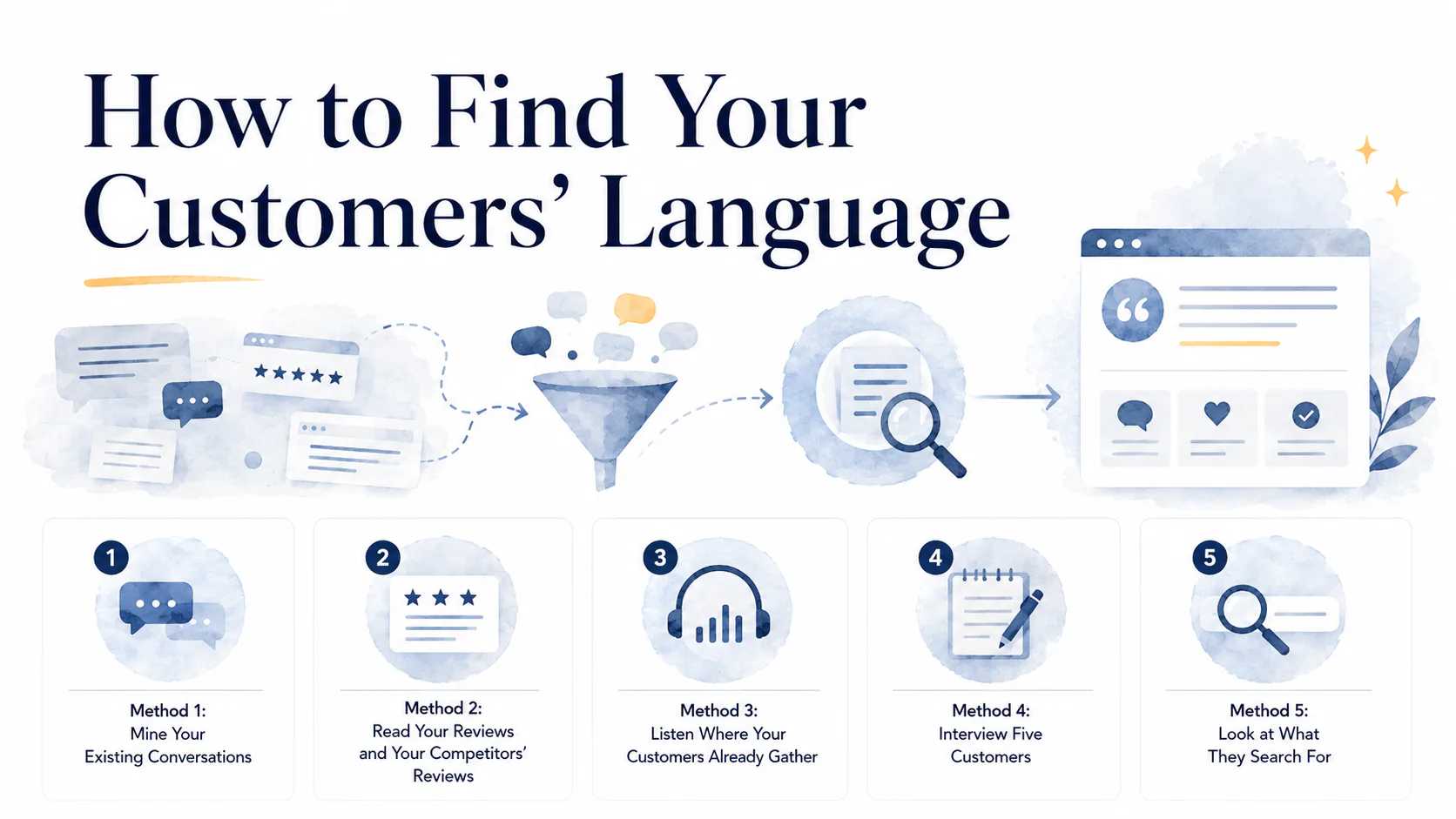
How to Find Your Customers’ Language
The principle behind every method below is the same. Go where your customers already talk. Pay attention to the words, not just the sentiment. Five methods, in rough order of effort.
Method 1: Mine Your Existing Conversations
You already have a goldmine. Sales calls, support tickets, live chat transcripts, email threads. Every one of these is a record of a customer using their own words to describe what they need.
Pick the last 20 sales calls or support emails. Read them with a highlighter. Three things to flag.
- The phrase a customer uses to describe the problem before you’ve explained anything
- The way they describe what they want the outcome to be
- The questions they ask that you didn’t expect
Write down the exact phrases. Don’t paraphrase. The wording is the data.
Method 2: Read Your Reviews and Your Competitors’ Reviews
Reviews are voluntary, written, and emotionally honest. Your customers are telling you what they actually thought, and they’re using their own words to do it.
Read your own reviews. Then read your three closest competitors’ reviews. Look for the patterns. What people praise. The recurring complaints. The things they wish were different. Note the words that come up across multiple reviewers.
This is the cheapest customer research available. It’s already been done for you.
Method 3: Listen Where Your Customers Already Gather
Your customers exist in places online. Look for them in forums, subreddits, LinkedIn groups, industry Slack communities, and comment threads on the publications they read.
Spend an hour a week reading, not posting. You’re there to listen, not to pitch. Pay attention to how people describe their work, their frustrations, and the solutions they’ve tried. The phrases that come up over and over are the phrases your customers expect to read on your site.
Method 4: Interview Five Customers
This is the highest-effort method on the list, and it isn’t for every business. It works best when you know your customers by name. This includes B2B, professional services, government, and agencies with repeat clients. If your customer base is thousands of one-off transactions, skip ahead to Method 5.
Five customer interviews will teach you more than most agencies learn in a quarter. The trick is to ask open questions and shut up.
A few that consistently work.
- How would you describe what we do, to a colleague?
- What were you trying to solve when you came to us?
- What nearly stopped you from going ahead?
- What do you actually use us for, day to day?
Record the calls with permission. Transcribe them. Look for the phrases that show up again and again. Those are your headlines, your section openers, your subheadings.
Method 5: Look at What They Search For
Your search console, your site search data, and tools like Answer the Public will show you the exact words people type when they’re looking for what you do.
Search queries are pure customer language. People type the way they think, especially on mobile. If your customers are searching “how do I stop my website from getting hacked” and your page is titled “Enterprise Cybersecurity Posture Management,” you’ve got a gap to close. Writing copy that matches search intent starts with using the same words your customers use to find the problem.
How to Use Customer Language in Your Copy
Finding the language is half the work. Using it is the part most brands get wrong.
Copying your customers word-for-word doesn’t work. Internet slang on a corporate site reads as costume. The point is to fold their language into yours, so the reader sees themselves in your copy without feeling pandered to. A few practical rules to apply.
Use their nouns. If your customers say “leaky tap” and your industry says “tapware fault,” use leaky tap. The noun is where the recognition happens. The rest of the sentence can be yours.
Match their level of formality. If your customers write in full sentences and use commas, match that. If they write in fragments and skip punctuation, you can still write in sentences, but lose the corporate stiffness.
Lead with their problem, not your service. Open with their description of the problem. Your service comes next. This is one of the easiest ways to test whether you’re writing in customer language. Read the first line of your homepage. Does it describe a problem your customer would recognise, or a service category you sell?
Test against a real person. Read your draft out loud. Picture an actual customer saying these words back to you. If you can’t, rewrite.
This isn’t about dumbing down your copy. It’s about making sure the reader gets to your expertise without tripping over the language on the way in.
The Trap Most Brands Fall Into
There’s a mistake brands make once they’ve decided to take customer language seriously. They start cosplaying.
Suddenly the website is full of “yeah, we get it” and casual contractions and a tone that’s working overtime to sound human. It reads worse than the corporate version, because it’s pretending. The reader can feel the strain.
Customer language is not a voice. It’s a source.
You don’t replace your brand voice with your customers’ voice. You let what they say shape what you write. Your tone is still your tone. Your warmth, directness, expertise. All of that stays. What changes is the words you use to describe problems, the order you raise them in, and the things you choose to talk about. The voice is yours. The language is theirs.
How This Plays Out in Practice
A practical version of all of this. Block out two days. Day one is collection. Read 20 sales emails. Read your reviews and those of three competitors. Skim a forum or two. Take notes in a single document and copy phrases verbatim.
Day two is application. Pick your three most important pages. Rewrite the openings using the phrases you collected. Test them on someone outside the team who fits your customer profile. If they read the opening and say, “yeah, that’s the thing I was looking for,” you’re done. If they read it and say, “I think that’s about X,” you’re not.
The work is small, but the payoff is huge. A few good strategic decisions about content made now will shape the voice of everything you publish for the next two years.
If your website still describes your customers in your industry’s words, you’re losing readers in the first paragraph. Reading 20 sales emails this week is a good way to find out which words to change. The fix is rarely a full rewrite. More often it’s a sharper opening line and a few replaced nouns.
Talk to us about your content.